The most devastating earthquakes in the Far East. What you need to know

On the night of July 30, one of the most powerful earthquakes in the history of Russia occurred in Kamchatka. Aftershocks of magnitude 8.7 occurred in the Pacific Ocean east of Petropavlovsk-Kamchatsky. This time, no casualties were avoided, although many tragedies have occurred in the Far East in the past due to similar natural disasters. How Kamchatka, the Kuril Islands and Sakhalin experienced the strongest earthquakes — in the material of Izvestia.
Earthquake in Kamchatka in 2025 — 8.7
• The earthquake that occurred on July 30 off the coast of Kamchatka became the second most powerful in the history of Russia. Its magnitude was 8.7. Due to the fact that the epicenter was located 161 km from Petropavlovsk-Kamchatsky and lay at a depth of 32 km, casualties and major damage were avoided.
• In the capital Kamchatka, the wall of a kindergarten closed for repairs collapsed, and the power grid was damaged. In Severo-Kurilsk, the port was flooded due to the tsunami, ships were washed ashore, and furnace risers in residential buildings collapsed. About 2,400 people were evacuated to higher ground on Sakhalin. Tsunami waves have reached Japan, Hawaii and the coast of the United States.
Earthquake in Kamchatka in 1952 — 9.0
• The earthquake that occurred on November 5, 1952, remains the strongest in the history of Russia. It also led to the largest number of victims. The tremor was recorded in the Pacific Ocean 180 km from Petropavlovsk-Kamchatsky and caused a series of powerful tsunamis that brought destruction to the 700-kilometer coastal strip.
• The city of Severo-Kurilsk, located on Paramushir, the second island of the Kuril Ridge from Kamchatka, suffered the most damage. The tsunami hit him in the early morning just 35 minutes after the earthquake. A wave up to 15 m high immediately washed away several residential buildings on the shore. After it, the residents who had managed to escape began to return, but 20 minutes later they were covered by an even more powerful wave, which caused the greatest number of victims and destruction. The third stage of the tsunami finally destroyed the city.
• Preliminary data showed that 2,336 people died in Severo-Kurilsk and other settlements of Paramushir, and about 200 more died in Kamchatka. Later estimates allowed for the deaths of up to 4,000 people. The tragedy was not reported in the central and Kamchatka newspapers, the general public learned about it only in the 1990s. The city of Severo-Kurilsk, which had lost almost its entire population, was rebuilt on higher ground.
Earthquake on Sakhalin in 1995 — 7.0
• Almost all other earthquakes in the Far East with a magnitude above 7 usually occurred underwater in the Pacific Ocean. If they led to any casualties, it was on a much smaller scale. The exception was the magnitude 7.6 earthquake on Sakhalin on May 28, 1995. It occurred in the northern part of the island, in an area inhabited by more than 55,000 people.

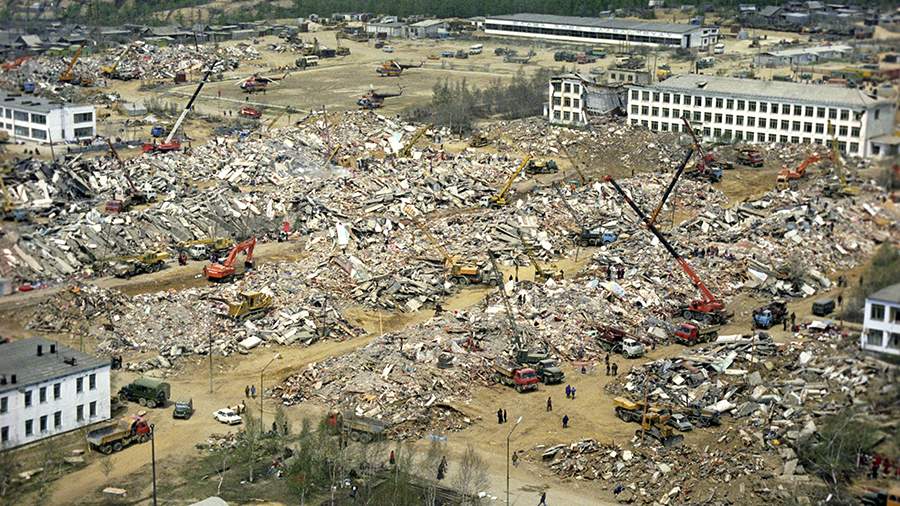
• The tremors occurred in the immediate vicinity of the village of Neftegorsk. Of the 3,200 residents, 2,040 people died under the rubble. The earthquake disrupted telephone communication, which is why it was possible to inform the authorities about the scale of the disaster only nine hours later. A day later, rescuers of the Ministry of Emergency Situations arrived in the destroyed Neftegorsk, who managed to pull more than 500 people out from under the rubble. The settlement was no longer being rebuilt.
Earthquake in Kamchatka in 1923 — 7.3
• The winter and spring of 1923 were the time of a series of powerful earthquakes off the coast of Kamchatka. One of them, which occurred on April 13 and reached magnitude 7.3, caused a particularly strong tsunami that struck the coast of the peninsula near the village of Ust-Kamchatsk.
• Two large waves resulted in the deaths of 23 residents, mostly Japanese who worked there. The total number of victims with surrounding settlements reached 36. In some places, the height of the tsunami reached 30 m, which caused the wave to penetrate to a depth of 8 km, washing away trees in its path. Nerpichye Lake in the vicinity of Ust-Kamchatsk turned from fresh to salty after the tsunami.
Earthquake in the Kuril Islands in 1918 — 8.1
The next largest earthquake occurred on September 8, 1918, near the Kuril island of Urup, when it still belonged to Japan. The tremor occurred in the Pacific Ocean 200 km from land and reached a magnitude of 8.1.
At that time, there were 60 workers on the island who were engaged in lifting the wreck. They were not injured by the earthquake, but because of the rain, everyone quickly took shelter in their homes. Half an hour later, they were hit by a tsunami. 23 people were killed and seven others were injured.
Earthquake in the Kuril Islands in 1994 — 8.3
• One of the most powerful seismic events in the Far East occurred on October 5, 1994 in the area of the Southern Kuril Islands. Its magnitude was 8.3, which allowed it to be among the five strongest earthquakes in Russia.
• The greatest damage was caused to settlements on the islands of Shikotan and Iturup. 12 people died from the destruction of houses, and oil leaked from storage facilities in the villages of Malokurilskoye and Krabozavodskoye. The tremors were followed by a tsunami, but it did not lead to casualties — the locals knew about the danger and left the dangerous areas.
Переведено сервисом «Яндекс Переводчик»
