Mining profession: how is humanitarian demining taking place in Donbas

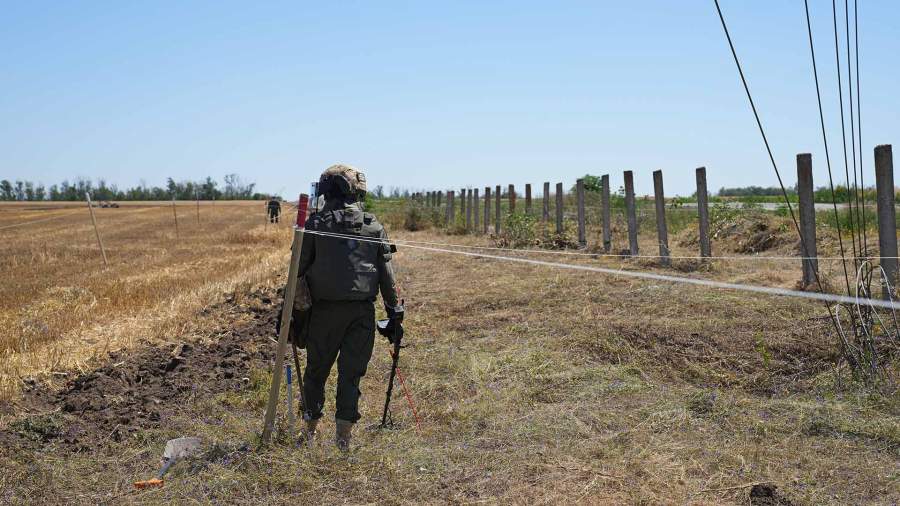
The Donetsk–Mariupol highway. The usual traffic flow. Sown fields. Over the past month, early in the morning, before sunrise, groups in bulletproof vests and helmets with visors have been appearing here — humanitarian demining units. Their task is to clear the territory for wiring power lines to cell towers in 16 sections along the highway: mobile communications in the new regions should be along all highways. About how humanitarian demining takes place in Donbass, what can be found in sunflower fields and what a sapper should never think about — in the Izvestia material.
Breakdown — marking — clearance
In the territory along the former line of contact in Donbass, civilians seem to pay almost no attention to whether it is dangerous or not. On the vast lands in the same Volnovakha region, crops are growing and sunflowers are turning yellow. Agricultural machinery is humming. Cars are rolling in all directions. But the picture is actually not as rosy as it seems at first glance: at one of the points on these fields, for example, there are still unexploded antipersonnel mines, nearby are the former positions of the Armed Forces of Ukraine with all the consequences. And in general, in any, the most unexpected place, there may be a grenade or a charge from a VOGUE under your feet.
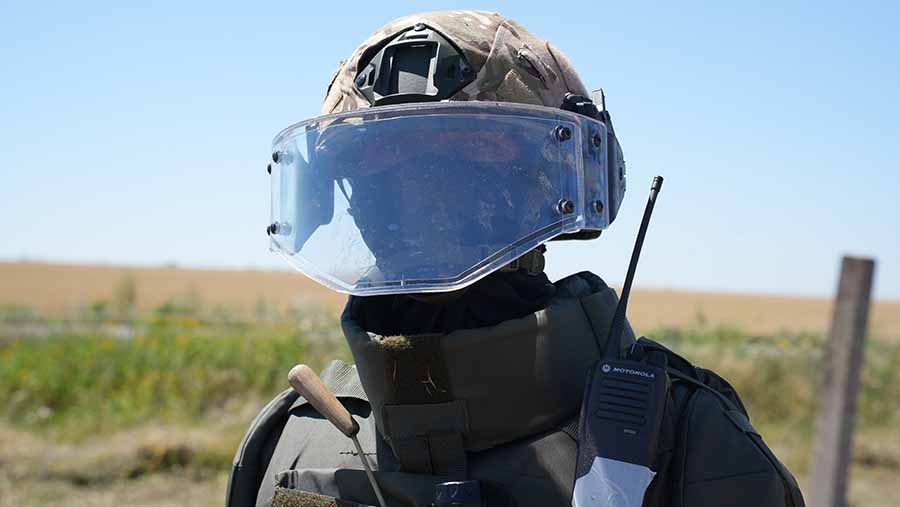
"In total, we have four groups of sappers involved," Vyacheslav Kovalevsky, executive director of the private sapper company Shield and Sword LLC, colonel of the reserve of the engineering Troops, tells Izvestia. — The scope of work is 30 hectares, the length of the line is 26 km. Difficulty category — the first: There was fighting, shells were falling, but there are no minefields.
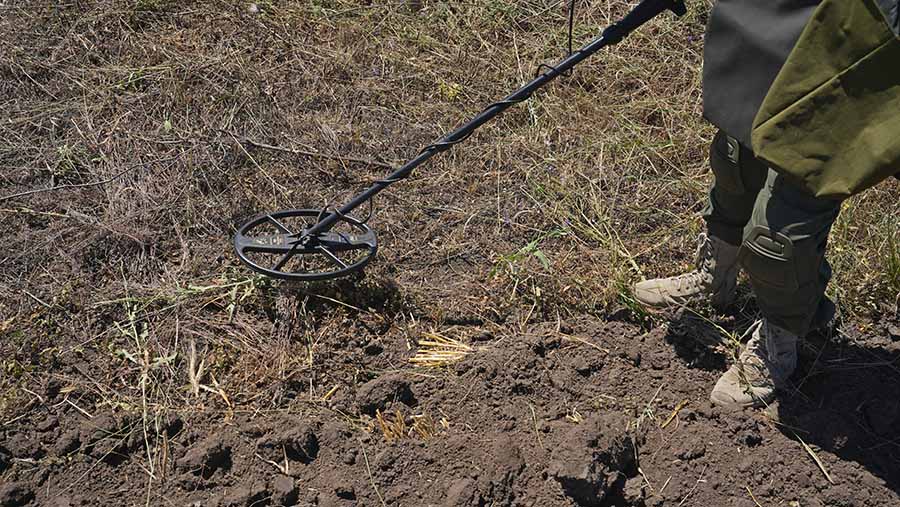
Private companies are the realities of our time, explains Kovalevsky. Without them, given the scale of the land that has not been cleared of explosives, as well as the shortage of qualified personnel, the Ministry of Defense and the Ministry of Emergency Situations simply cannot cope. The Shield and Sword entered the Volnovakha district in early July. First of all, the sappers cleared the passages for the surveyors, who carried out a breakdown and determined the parameters of future work sites. Then they made a marking — using twine and pegs, they fenced off the dangerous territory that should be traversed. And then they took up the tools — a probe and a metal detector.
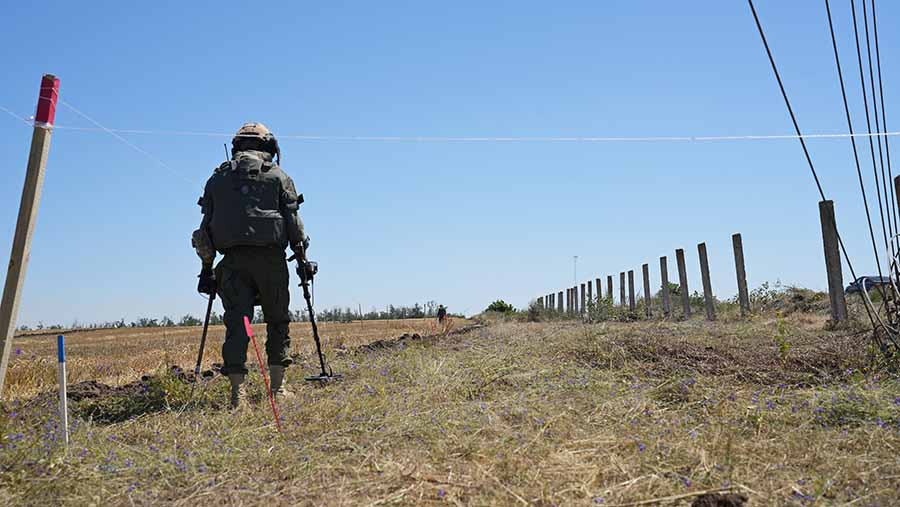
The schedule is from four in the morning to noon, so that the heat doesn't bother you so much. There are 15 minutes of rest at the end of each hour. Productivity per shift is 1.6 thousand square meters per person.
Red, Yellow, Green
The difference between humanitarian and military demining is that sappers need to remove every single metal object from the ground, down to the last rusty nail and aluminum can. Only after that, the work is considered completed, and the territory is suitable for any production activities and generally safe stay of a person there.
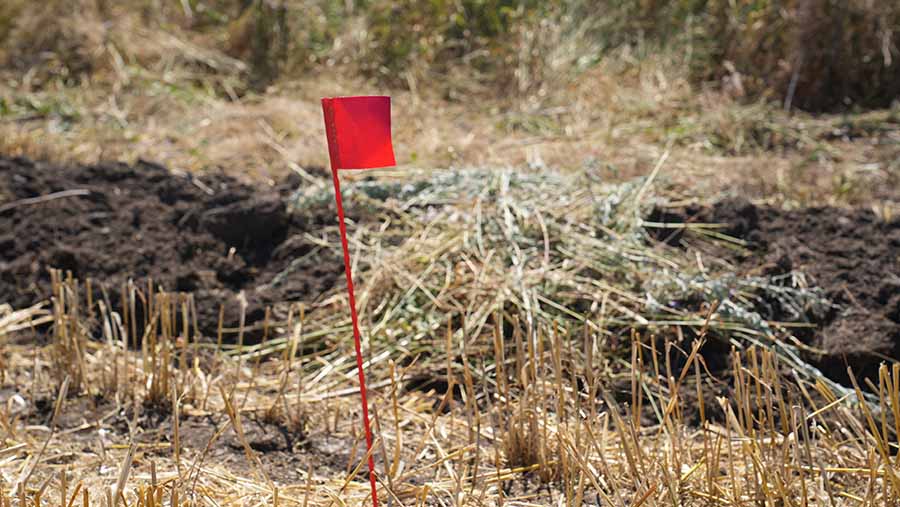
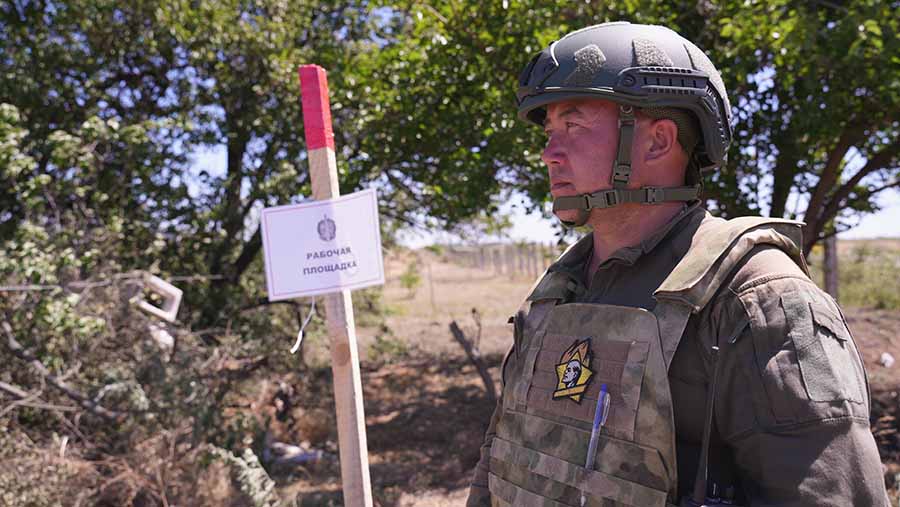
The squares inside the boxes (work areas) are marked with special pegs with colored heads: red — danger zone, white — safe, blue — start of work, yellow — place of detection and removal of an explosive object, green — destruction. The depth of the examination is half a meter, in some cases up to two meters: each depth uses its own device.
Vyacheslav Kovalevsky has 30 years of service under his belt, starting as a platoon commander and ending up as a brigade commander. Participated in many local conflicts. He has three orders of Courage. Over the past year, he has led humanitarian demining in the LPR, the DPR and the Kherson region. So, in the village of Shchastya, for example, his team neutralized precisely the minefields, including anti-tank ones, in total they managed to extract more than 400 ammunition. In Kherson, it was necessary to clear the area for laying a high-voltage power line. In addition to modern explosives, many surprises have been discovered since the Great Patriotic War, from warheads for German Oerlikon anti—aircraft guns to shells for our T-34 tanks.
An echo of distant days
The head of field work at all 16 sites is Alexander Sabitov, also a colonel in the reserve, formerly the head of the engineering group in Syria. He has thousands of neutralized items in various geographical locations. A notable moment is that in 2012, he participated in the Victory Day parade on Red Square, representing the 45th Separate Guards Engineering Brigade.
— I was engaged in the preparation of calculations — two boxes of 200 people each, — says the military. — The training sessions were held from December to May. First in the unit, then at the training ground. On the eve of the parade, we held three rehearsals on the Red Square itself — two at night and one during the day. On May 9th, they marched with a bang. Remembered for the rest of my life. Participation in such an event is, of course, one of the key events for any military man. And honor," Sabitov shares.
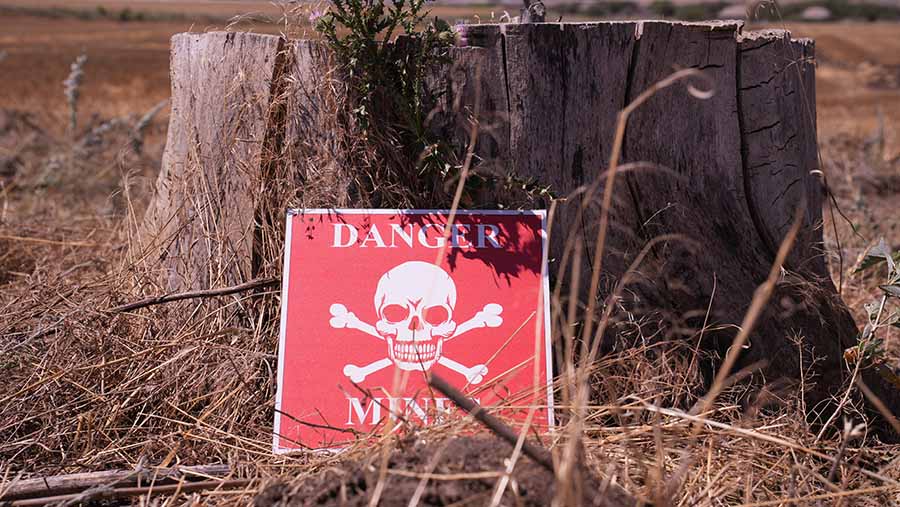
He once gained experience in humanitarian demining on the territory of the Leningrad Military District, where he and his colleagues defused warheads during the war. In one place, for example, they found 100 artillery shells, each weighing 55 kg, and they were as good as new, even if they were loaded now. In another, there is a whole minefield of 25 German anti—tank mines arranged in a checkerboard pattern.
Special character
A minesweeper is a profession that requires a special kind of character: concentration, balance, and concentration (more than 50% of candidates do not pass the examination when applying to private companies). Alexander Sabitov emphasizes that it is extremely important not to lose what is called a sense of danger when going out into the field. That is, in no case imagine yourself as a pro who knows everything and who doesn't care about anything: as soon as such a feeling arises, expect a mistake.
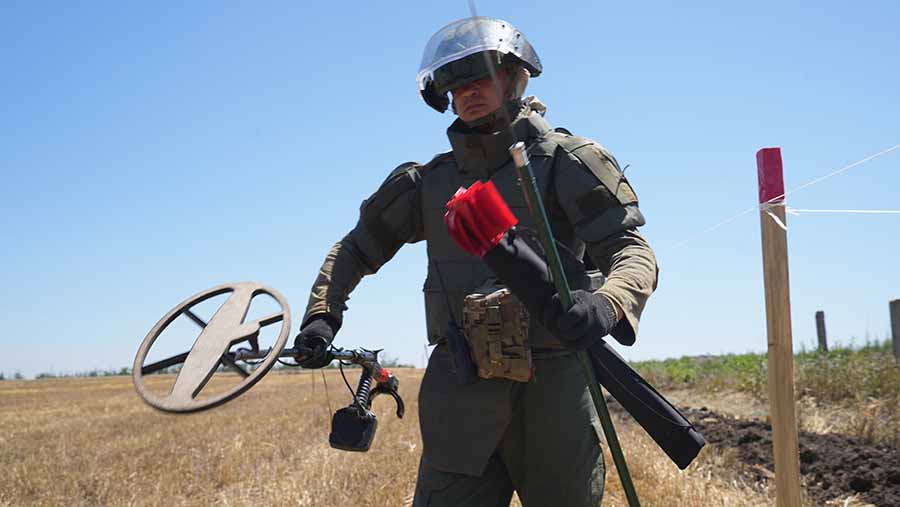
His ward, Nikolai, the call sign of the Witch Doctor, adds that before going out, you should put everything out of your head. Nothing should worry you when you take the dipstick and lower the visor — neither the distant house, nor the upcoming Sunday vacation, nor the news you read in the morning, just a strip of land in front of your eyes.
The experience of a Medicine Man is 24 years. He started as a dog handler, then as a dog sapper. In the early 2000s, he traveled to Croatia, Bosnia, and Serbia. So humanitarian demining became his destiny. Since 2022, he has been working in new territories. Recent results include the discovery of almost a thousand mines and other explosives in Mariupol in 3.5 months.
On the machine
An important skill required by a sapper is first aid. There are a lot of cases of explosions in the CBO zone, including double ones (when one went to the aid of the other and suffered himself). Including among those involved in humanitarian demining. Hence the strict requirements: constant medical training.
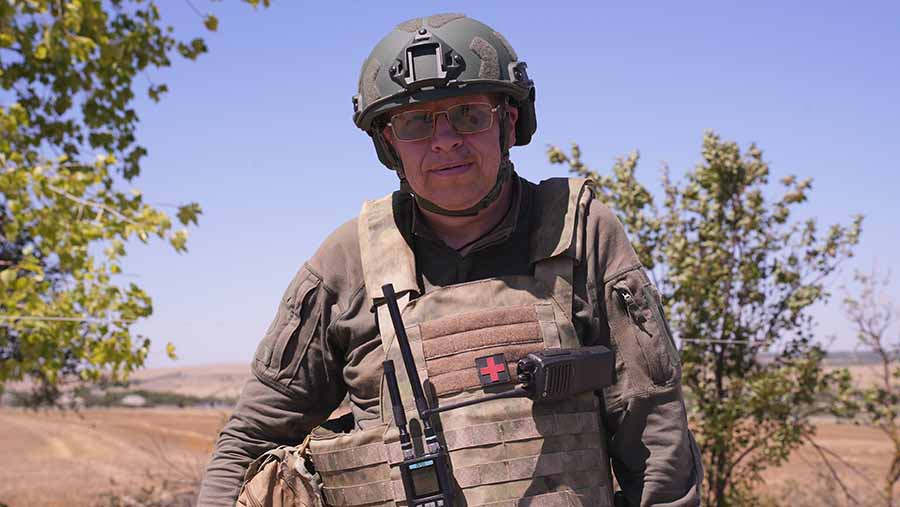
In the Shield and Sword squad, paramedic Vadim Kukhtiev, call sign Doc, is responsible for this. He worked for an ambulance in his native St. Petersburg for 28 years. And in 2023, he went with the "humanitarian workers" to the free zone. He is responsible for monitoring the health of the sappers. Training every week: working with a tourniquet, tourniquet, bandages, evacuation from the battlefield, etc., so that the hands act automatically. And, of course, the willingness to provide assistance in case of emergency. The work profile, Doc explains, is relatively simple at this site. But in this case, all the more you need to be careful not to lose your vigilance.
Among the items found by the sappers in recent weeks are grenades of various types, small arms ammunition, high—explosive antipersonnel mines, grenade launcher fragmentation rounds, and UAV elements. The work continues.
Переведено сервисом «Яндекс Переводчик»
