
Back to the future: The US and the EU have concluded a trade deal
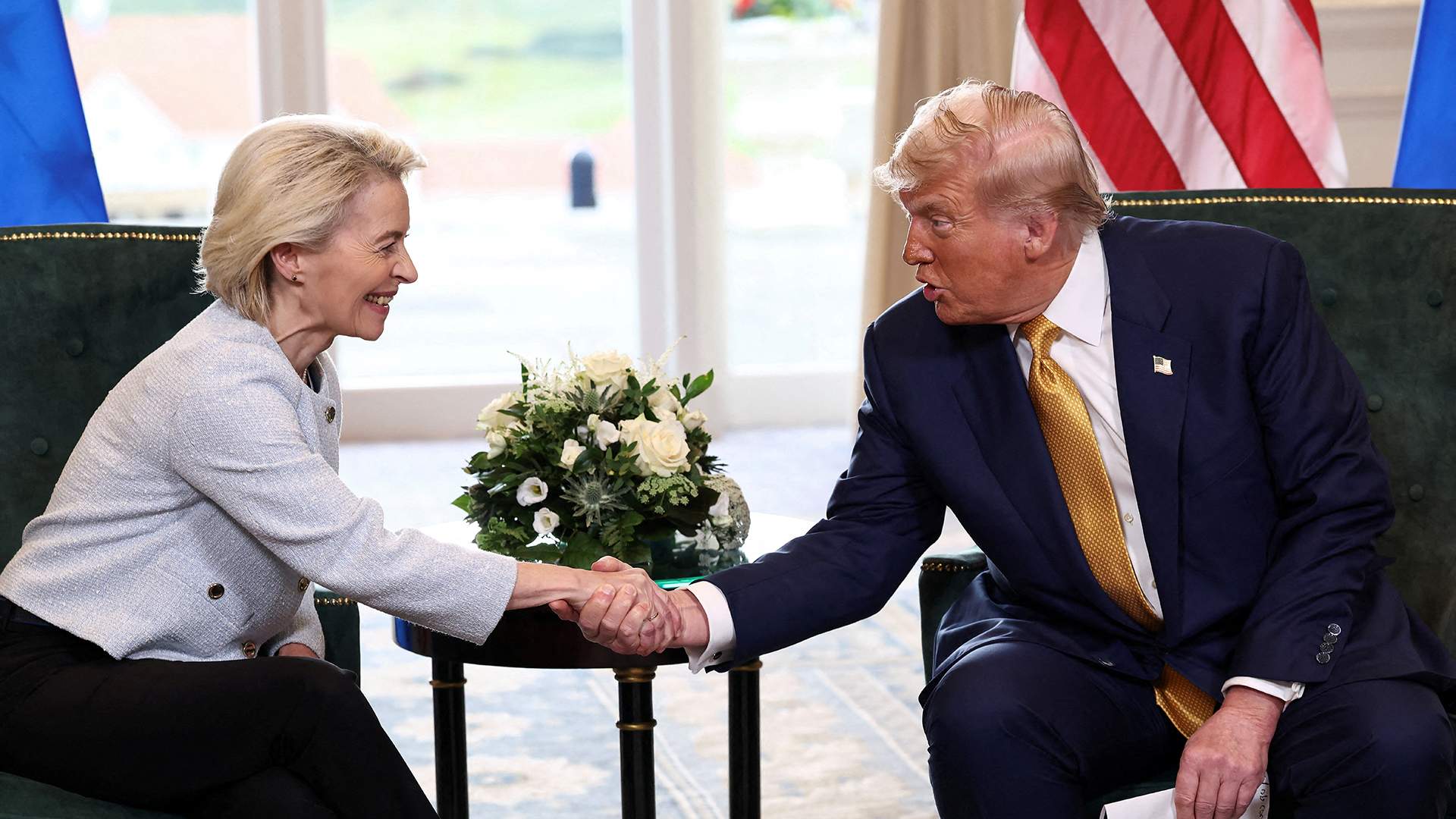
On Sunday, July 27, the United States and the European Union signed a trade deal, according to which Washington imposes 15% duties on European goods, and Brussels opens markets to American goods at a zero rate. This was done after negotiations between US Presidents Donald Trump and the European Commission (EC) Ursula von der Leyen, which took place in Turnberry (Scotland), while Trump called the deal "the largest of all." Russia believes that it will lead to the deindustrialization of Europe. Read more about the deal, as well as the reaction to it, in the Izvestia article.
The US-EU trade deal: what is known
On Sunday, July 27, the US and the EU signed a trade deal. After a conversation in Scotland with Ursula von der Leyen, US President Donald Trump called the agreement "the largest of all." This event was preceded by months of negotiations at various levels amid Trump's threats to impose duties of 30% on the EU from August 1. In response, Brussels has prepared counter-restrictions that could affect at least a third of American supplies to Europe.
After negotiations on July 27, the parties reached new agreements, which will include:
— opening of EU markets to trade with the United States with a zero duty rate;
— the introduction of 15% duties against the EU on most exports, including cars (effective from August 1, 2025; previously, shipments of cars and auto parts from the EU were subject to duties of 25%), as well as medicines;
— the EU's complete abandonment of Russian oil and gas;
— a commitment for the EU to purchase $750 billion worth of oil, gas, nuclear fuel, semiconductors and liquefied natural gas from the United States within three years.;
— Brussels' investment of $600 billion in the US economy and increased purchases of military equipment "by hundreds of billions of dollars";
At the same time, Trump still has the opportunity to raise tariffs in the future if European countries fail to fulfill their investment obligations.
"All countries will be open to trade with the United States, and they have agreed to purchase a huge amount of military equipment," Trump added.
It is also noted that the trade deal is not final, but reduces the risk of a transatlantic trade war with consequences that could further deepen the state of both economies.
Ursula Von der Leyen, in turn, noted that the negotiations with Trump were difficult: "I knew this from the very beginning, and it was really very difficult. But we have come to a good conclusion for both sides."
She also added that the deal "will bring stability and predictability." At the same time, zero tariffs will remain in place, which will be applied in a number of sectors, including, according to the head of the EC: "all aircraft and components, certain chemicals, certain generics, semiconductor equipment, certain agricultural products, natural resources and critical raw materials."
The economic aspect of the US-EU deal
Independent expert and economist Leonid Khazanov confirmed to Izvestia that the trade agreement is a big breakthrough for the United States, because they "pushed through" Europe's purchase of various American goods, the list of which is completely unknown, but may include radio navigation systems and much more.
This is also not bad for Europe, the expert believes, because customs duties of 15% are envisaged, and not 50% or 100% — this is a fairly preferential tariff. Nevertheless, it was the Americans who won this deal and achieved their goals.
— I think they will continue to push their interests. These may include supplies of electronics to the EU market, and agricultural products, because the United States is one of the largest producers of wheat, corn and soybeans, Leonid Khazanov believes.
As noted by Bloomberg, the US-EU trade agreement will allow the European car industry to earn an additional $4.7 billion. It eliminates trade uncertainty for European automakers. As automotive market analyst Matthias Schmidt told the agency, "This is the best outcome for what looked like a bad situation. I think the German and Swedish managers will sleep more soundly than they have in the last few weeks."
Against the background of the conclusion of agreements between the parties to the agreement, oil prices began to rise, according to Reuters: "Brent crude futures rose by 0.89% to $69.05 per barrel by 06:47 GMT (08:47 GMT), while futures for U.S. West Texas Intermediate crude oil were trading at $65.75 per barrel, an increase of 0.91%."
Analysts at IG Markets note that the US-EU trade deal is supporting global financial markets and oil prices: "Given that the risk of a protracted trade war and the importance of the August deadline for tariffs are gradually decreasing, the markets reacted positively."
Reaction to the US-EU trade deal
In Russia, the deal was assessed as a failure for Europe.
As Russian Foreign Minister Sergei Lavrov said, the deal will lead to the deindustrialization of Europe, and American energy resources will be significantly more expensive than Russian ones.
"It is clear that American energy resources will be significantly more expensive than Russian ones. It is clear that this approach will lead to the further deindustrialization of Europe, to the flow of investments from Europe to the United States. And, of course, it will be a very strong blow, first of all, energy prices, investment outflow, for European industry, European agriculture," Lavrov said at the XI All—Russian Youth Educational Forum "Territory of Meanings".
He also added that figures like EC President Ursula von der Leyen literally boast of following this path.
Dmitry Medvedev, deputy Chairman of the Russian Security Council, said that ordinary Europeans can simply sympathize, and also that "Trump has smeared Europe."
In his Telegram channel, Dmitry Medvedev noted that the deal with the EU is humiliating for Europeans, since it is beneficial only for the United States.
"And of course, the 'deal' is clearly anti-Russian in nature, prohibiting the purchase of our oil and gas. But if this is mostly business for Trump, then for the crazy old woman of Europe it is part of a neo—Nazi ideology that harms the well—being of its own citizens," Dmitry Medvedev wrote.
The trade deal was criticized by many European politicians.
Alice Weidel, co-chair of the right-wing Alternative for Germany (AfD) party, said on the social network X: "The EU has allowed itself to be cruelly deceived! The 15% duty, the obligation to purchase weapons and energy from the United States is not an agreement, but a slap in the face to European consumers and manufacturers!"
Dirk Yandura, head of the German Federal Association for Wholesale and Foreign Trade, called the agreement a "painful compromise": "The additional duty poses an existential threat to many of our merchants. Even if there is initial certainty about the terms of trade now, supply chains will change and prices will rise."
According to him, Europe now needs new trade agreements with the largest economic regions of the world, and the already agreed agreements must be ratified as soon as possible and without unnecessary bureaucracy.
"The agreement with the United States will have significant consequences for the country. It will cost growth, prosperity, and jobs. The only way to avoid this is to increase competitiveness," added Dirk Yandura.
Dutch Prime Minister Dick Schof noted that the EU-US trade agreement ensures greater market stability, however, the absence of duties "would be better."
"The agreement reached by the EU and the United States is vital for an open economy like ours. The annual exports of goods from the Netherlands to the United States exceed €50 billion.... Of course, the absence of duties would be better, but this agreement provides greater transparency for our enterprises and greater market stability," he wrote on the social network.
In turn, German Chancellor Friedrich Merz welcomed her, saying that she had prevented a trade conflict that would have severely affected Germany's export-oriented economy and its large automotive sector.
Benjamin Addad, Minister Delegate for European Affairs at the French Foreign Ministry, shares the same opinion: "The trade agreement concluded by the European Commission and the United States will bring temporary stability to economic entities threatened by the US customs escalation, but it remains unbalanced."
He also added that "the current state of affairs is unsatisfactory." In his opinion, the European Union must fight to maintain a balance of interests in trade with the United States.
Slovakia's Environment Minister Tomasz Taraba wrote that in the context of the trade agreement, "if anyone needs to be congratulated," it's Donald Trump. He also added that the EU had "weak cards" during the negotiations and it was clear that everything would end "badly or very badly" for Europe.
"Today we are glad that it is "only" bad... However, we cannot blame President Trump for this, but it reflects the sad reality that the Brussels economic policy of recent years has brought Europe to," Tomasz Taraba said.
Переведено сервисом «Яндекс Переводчик»
