Trump has signed a trade agreement with the European Union. What the media is writing

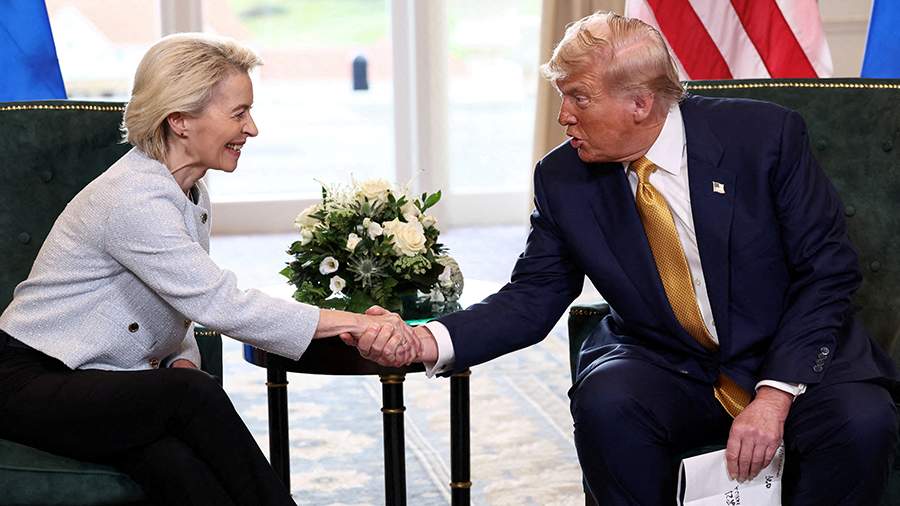
US President Donald Trump has announced a trade deal with the European Union. European imports will be subject to 15 percent duties, and Europe is also committed to purchasing $750 billion worth of energy from the United States. Investors welcomed the agreement favorably, as it will avoid a major trade war. What the media write about the deal is in the Izvestia digest.
Bloomberg: The United States has concluded a trade agreement with the European Union
The United States and the European Union have agreed on an agreement under which the bloc will face 15 percent tariffs on most of its exports, including automobiles, but avert a trade war that could deal a devastating blow to the global economy. The agreement was concluded less than a week before U.S. President Donald Trump's increased tariffs were due to take effect, and was quickly approved by several European leaders, including German Chancellor Friedrich Merz and Italian Prime Minister Giorgio Meloni.
Bloomberg
Trump and European Commission President Ursula von der Leyen announced the agreement on Sunday at his golf club in Turnberry, Scotland, although they did not disclose all the details of the agreement or release any written materials. The 15% rate will take effect on August 1, an American official said. "This is the biggest deal of all," Trump said, and von der Leyen added that it would bring "stability" and "predictability."
Von der Leyen said that the purpose of the agreement is to restore the balance of the trade surplus with the United States. However, such compromises stipulated by the agreement have angered some European industrial groups, with Germany's main lobby saying it "sends a fatal signal to the closely intertwined economies on both sides of the Atlantic." Von der Leyen and Trump also disagreed on some key terms of the deal they announced. The US president said the tariff would apply to "cars and everything else," but not to pharmaceutical products and metals.
Reuters: Stocks are rising and the euro is stabilizing
Global stock indexes rose and the euro strengthened after the US-EU trade agreement improved sentiment and brought some clarity ahead of this week's meetings of the Federal Reserve and the Bank of Japan. European futures were up more than 1%, S&P 500 futures were up 0.5%, and Nasdaq futures were up 0.6%.
Reuters
The countries are seeking to conclude trade agreements before the August 1 deadline set by US President Donald Trump, and talks between the US and China are scheduled for Monday in Stockholm amid expectations of another 90-day extension of the truce between the world's two leading economies.
The euro strengthened across the board, rising against the dollar, pound sterling and yen. Although the base tariff of 15% will still be perceived by many in Europe as too high compared to Europe's initial hopes of concluding a zero-on-zero tariff agreement, it is better than the 30% rate that Washington threatened. The U.S.-EU agreement brings clarity to companies and prevents a larger trade war between the two allies, which account for almost a third of global trade.
CNN: Trump touts "the biggest deal ever made"
Speaking with von der Leyen at a golf course on the west coast of Scotland, Trump said that the EU had agreed to purchase $750 billion worth of energy from the United States and invest another $600 billion in the United States. Although the details of the deal were not disclosed, Trump called the agreement with the bloc "the largest deal ever concluded."
CNN
"All countries will be open to trade with the United States at zero duties, and they agree to purchase a huge amount of military equipment," Trump added.
According to the US Department of Commerce, the EU and the US collectively exchanged goods worth $975 billion last year. The trade agreement, although far from final, reduces the risk of a transatlantic trade war that could have consequences for the global economy. The 15 percent duties on all goods include pharmaceuticals— the main commodity imported by the United States from the European Union for $155 billion.
Financial Times: EU caved in under the onslaught of Trump's tariffs
Trump's massive tariffs have sent financial markets into a state of free fall. When asset sales intensified, Trump backed down and reduced duties to 10%, calling it a temporary measure. But Brussels also made concessions. He canceled retaliatory duties and accepted the US offer to negotiate, even though the EU had a knife in front of its throat: 10 percent duties on most of its goods, as well as higher fees on steel, aluminum and vehicles.
Financial Times
Instead of following the example of Canada and China and taking immediate retaliatory measures, the EU, hampered by disagreements between the participating countries, decided to compromise in the hope of concluding a better deal. The relief that politicians felt by avoiding an immediate transatlantic trade war was overshadowed by regret: could the EU, the world's largest trading bloc and presumably an economic heavyweight, have achieved more favorable terms if it had not backed down at the very beginning?
Trump considers the EU to be a parasite that feeds off the lucrative American market, while simultaneously closing its own with the help of rules and standards. The US president said that the European Union was "created to deceive the United States" and that it is "nastier than China."

Axios: trade agreement will allow the EU to get rid of Russian fuel
The new trade agreement includes a commitment from Europe to purchase $750 billion worth of American energy. Von der Leyen said that this would help the bloc to continue to abandon Russian gas. As she told reporters in Scotland, $750 billion will be distributed over three years.
Axios
"We still have too much Russian LNG coming through the back door to our European Union," von der Leyen said, also mentioning the continued supply of oil. "We want to completely abandon Russian fossil fuels, and therefore it would be very useful to purchase more affordable and high—quality LNG from the United States," she said.
There is still no detailed information on how to make such a significant promised increase in imports a reality. ClearView Energy Partners noted that even if the $250 billion per year includes existing energy exports from the United States to the EU of about $78 billion per year, this would still be too significant a jump.
Переведено сервисом «Яндекс Переводчик»
