"Our task is to help manufacturers reduce the cost of production"

By 2030, it is planned to increase the volume of agricultural production by 25%, and agricultural exports by 1.5 times, to $55.2 billion. To achieve these goals, a new national project on the technological renewal of the agro-industrial complex was launched in 2025. Maxim told Izvestia about how to bring agriculture to a new level, ensure technological sovereignty and increase production efficiency.
Sazonov, a shareholder of NPAO De Hes, is one of the leading Russian manufacturers of premium—class premixes, starter packs and compound feeds for farm animals and birds.
Animal husbandry is a priority
— According to Rosstat, in 2024, the production of compound feeds increased by 3.3%, and the production of premixes increased by almost 5%. How is it possible to increase production volumes even in difficult economic conditions?
— Dejes is an advanced full-cycle enterprise, which is not inferior to any European plant in terms of level. Our production is self—sufficient, from the development of formulations to the implementation of innovative solutions. We create our own products that take into account the specifics of the Russian agro-industrial complex, develop feeding programs and veterinary support for agricultural enterprises, and organize
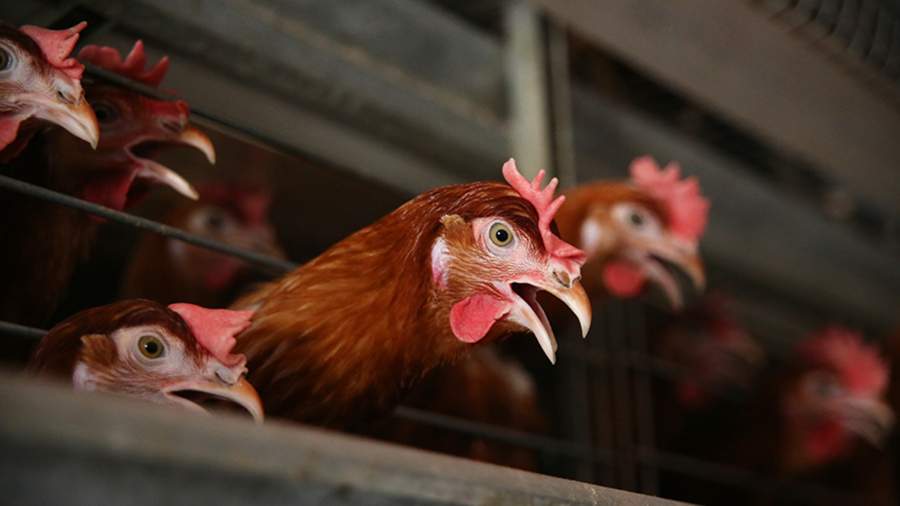
high-precision analyses of raw materials and finished products. We have about 300 partners in Russia alone, and the list is growing. So, in 2024, we shipped premixes to pig farms to produce 1 million tons of feed, resulting in the production of more than 400 thousand tons of meat. In the poultry sector, 20 million laying hens and 27.5 million broilers consume our products daily, which allows us to produce 6.5 billion eggs and 725 thousand tons of meat every year. We also ensure stability and high performance in the production of livestock products by cooperating with most of the country's largest agricultural holdings (36 out of the top 50).
At the same time, we are constantly developing — investing in technology, state-of-the-art equipment, and employees. For 16 years of work, our company has been able to form an outstanding team of technologists, engineers and specialists whose knowledge and experience allow them to meet international standards. Now we are actively working with Asian representative offices: it is there that the most advanced in the world are concentrated.
research and technology in our industry. At the same time, we are developing our own research areas in order to gain greater independence. Our priority is not just to do business for the sake of current profits, but also to lay the foundation for long—term development. This is especially important in the current environment, when issues of food security and technological sovereignty of the country have come to the fore.
— Does the state help you?
— Yes, there are measures whose benefits cannot be overestimated. In particular, preferential lending programs from the Ministry of Agriculture and a set of measures that the government has developed to support exports. De Hes supplies about 15% of its total production to other countries annually, and we export premixes to Belarus, Uzbekistan, Kazakhstan, Armenia, Kyrgyzstan, Tajikistan, and other countries. Given the large pool of foreign partners — we have more than 50 of them — state support for Russian enterprises is very important.
An inside look at feed production
— What problems do you have to face in the feed industry?
— The feed industry is a high—tech and knowledge-intensive process. From a business point of view, the industry is also not easy. The prices of raw materials for feed, premixes and pre-starters are formed under the influence of a number of factors, from weather conditions and fuel costs to the geopolitical situation. Traditionally difficult logistics add additional complexity. When building supply chains, it is necessary to take into account port congestion, changes in customs procedures, border closures, and more. There are also local difficulties. For example, due to the large-scale reconstruction of BAM, there are interruptions in rail service and the availability of wagons.
— You mentioned a high-tech process. How complex is the premix formulation? Do you use our raw materials or foreign ones?
— We use a lot of ingredients. Currently, about 400 different components are stored in the company's warehouses, which we mix to create unique formulas. We develop up to 500 types of products from these ingredients. And, unfortunately, we still buy many ingredients (and not only expensive ones) abroad. For example, manganese is imported from Chile, Peru, and Georgia; zinc and copper sulfate are imported from China.
— Why is this happening? Is there really no such raw material in Russia?
— We need raw materials of a certain quality that meet strict standards. And if, for example, we can buy magnesium in Chelyabinsk, then iron oxide (in fact, an ordinary mineral, unprocessed ore) has to be imported from China, because we do not have a product that meets the necessary standards. Or, let's say, copper. And our manufacturers are not interested in producing such a small volume of products with the quality we need, so we are forced to import again.
— How can this problem be solved?
— We constantly analyze each item to determine whether it is possible to purchase it in Russia. If not, we are studying whether we can produce it ourselves. We are talking about the kind of production that we can do, taking into account the knowledge that the factory team has. For example, my father is an honored geologist of Russia, and his expertise helps us work with the mineral component. So, now we are trying to figure out whether we can take the waste from our copper producers, refine it ourselves and then use it to abandon imports.
Or take, for example, absorbents — these are materials that absorb various contaminants. In Russia, it is customary to use expensive imported absorbents. But we can create them according to our own recipes from local clays. Why import a product for such a high price if we can produce it ourselves cheaper? It is important for us not only to ensure high-quality products, but also to minimize costs while maintaining a local approach to production.
The Russian agro-industrial complex has global goals
— What strategic objectives do you set for Dejes as the founder of the company?
— The main focus of our work today is the creation of domestic analogues of key technologies that we use in feed production. An equally important task is the development and scaling of our effective feeding programs, which directly affect the profitability of agricultural enterprises. Together with the country's leading research centers, we are developing innovative specialized products that allow us to achieve new levels of productivity in all segments of animal husbandry.
Today, Russia fully provides itself with pork, broiler meat and eggs. Therefore, the primary task now is to increase exports. In order to be competitive in the global market, it is necessary to reduce the cost of production and maximize the productivity of farm animals and birds. And the importance of balanced feeding here cannot be overestimated. In addition, we adapt to the narrowly focused demands of manufacturers and invent unique feed complexes that precisely deal with problems at enterprises. To meet demand, we are increasing production capacities, introducing advanced quality standards and strengthening the position of Russian agroexport, so that Russian agricultural products on the world market are always characterized by consistently high quality.
— What motivated you to enter such a difficult business?
— Animal health depends on the feed, and the quality of the products obtained, whether milk, meat or eggs, depends on animal health. Unbalanced feed disrupts the entire production chain, which ultimately affects the consumer. We want Russians, like people in other countries where we supply our premixes, starter packs and compound feeds, to consume natural and healthy products. This is a global goal. Despite the large number of difficulties, the feed industry is alive and constantly evolving: new technologies, research, and environmentally friendly solutions appear every year. Another advantage is the stable demand. There will always be people and animals, this market will never disappear.
Переведено сервисом «Яндекс Переводчик»
