Scientists spoke about the progress of Rosneft's program to preserve Arctic ecosystems
- Новости
- Local news
- Scientists spoke about the progress of Rosneft's program to preserve Arctic ecosystems

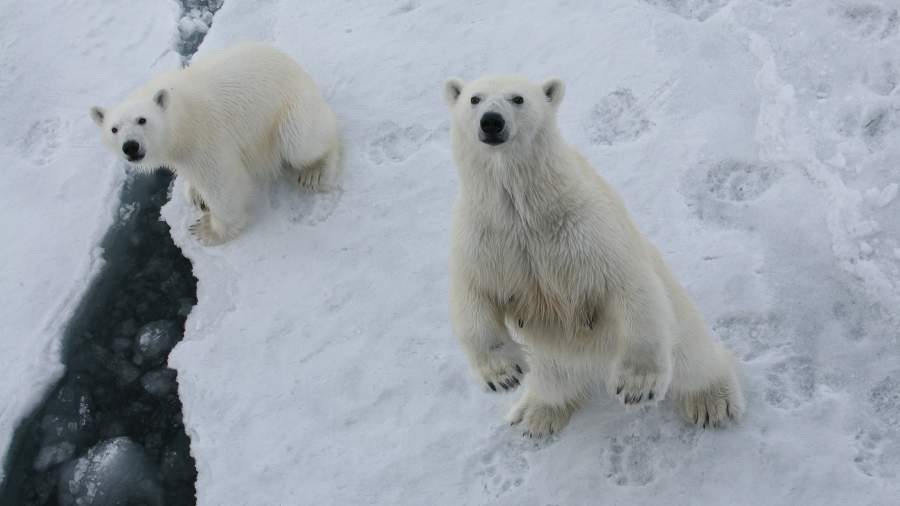
The data from the spring field research conducted as part of Rosneft's Tamura Arctic Ecosystem Biodiversity conservation program will help to comprehensively assess the number, lifestyle and health status of the Kara subpopulation of polar bears. This was announced at a press conference in Moscow by representatives of Rosneft and scientists from the Severtsov Institute of Ecology and Evolution of the Russian Academy of Sciences.
This year, researchers have conducted three polar bear research expeditions, including expedition work on the Taimyr Peninsula, aerial surveys of the polar bear population in the Kara Sea near the village of Sabeta and off Dixon Island. In total, the scientists made 25 flights to account for the animals, covering about 25 thousand kilometers.
According to the participants of the expeditions, this year's field work has become a continuation of last year's research. If in 2024 scientists assessed the Kara polar bear population during a difficult ice-free period for animals, then in the spring of 2025 they took into account and studied bears during the ice period, when animals actively hunt seals. This helped to assess the dynamics of population development. "The main works that were carried out in the areas inhabited by the Kara polar bear population are helicopter accounting, counting the number of animals, trapping with health assessment and tagging.
At the same time, the tagging carried out in the past and current years allowed us to establish a significant fact: as it turned out, during the work, not a single bear left the waters of the Kara Sea. This is an important result, indicating the special nature of this population: for example, the polar bears on Franz Josef Land, which we observed earlier, they move very actively. In addition, we have managed to collect a significant amount of biological samples, which will be studied at the laboratory stage of the program and will help to assess the health status of the population with considerable accuracy," said Ilya Mordvintsev, Candidate of Biological Sciences, leading researcher at the Severtsov Institute of Ecology and Evolution.
During the Tamura program, scientists are actively using new technologies that help them keep accurate records and monitor and analyze data faster. So, during the spring air surveys, scientists were able to put tracking tags not only for females, as was previously possible, but also for males: GPS devices for monitoring males have become a novelty of the scientific season. And at the laboratory stage of the study, the processing and analysis of approximately 170,000 photos taken during research missions will be taken over by an artificial intelligence-based program that will speed up work several times.
Olga Krever, Deputy Director of the Federal State Budgetary Institution Roszapovedcenter of the Ministry of Natural Resources and Ecology of the Russian Federation, explained that the partnership between the state and business in the field of environmental protection contributes to the introduction of the most modern technologies into environmental programs.
"The Ministry of Natural Resources and Environment is interested in ensuring that biodiversity conservation is carried out at a high level, so that the state, business, science, and civil society participate in it. This expands our capabilities and helps us implement modern world-class solutions. The Tamura program is a successful example of such work, and today the Ministry of Natural Resources and Environment has already signed an agreement with Rosneft to participate in the national Environmental Well—being project, designed until 2030," Olga Krever said.
Переведено сервисом «Яндекс Переводчик»
