- Статьи
- Army
- A million different roses: how a flower became a symbol of Donetsk's resilience and courage

A million different roses: how a flower became a symbol of Donetsk's resilience and courage
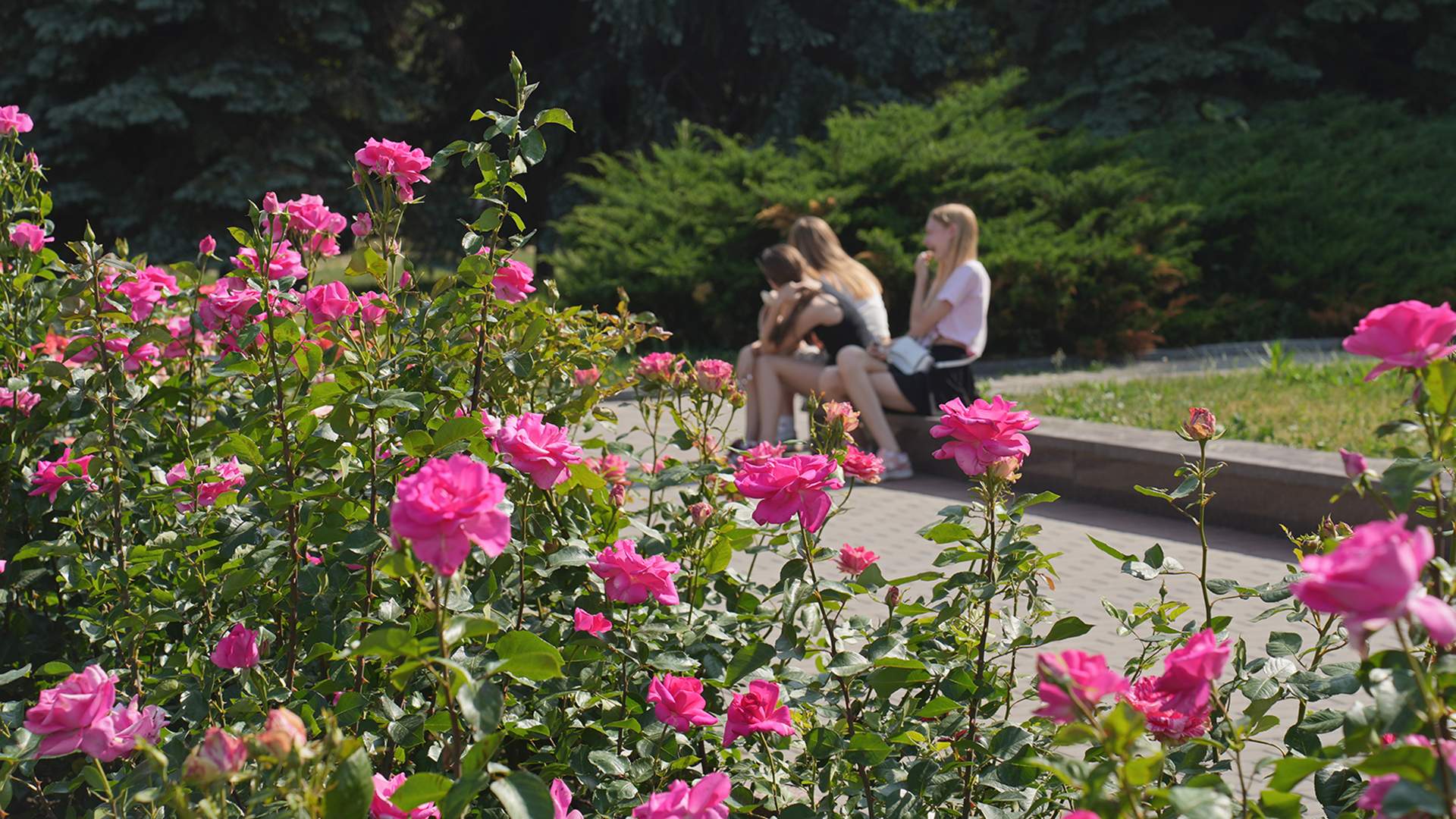
"Donetsk is the city of a million roses," any Donetsk resident will tell you, and you can see this when you get to the capital of Donbass. The most striking thing is that the DPR center did not lose its title during the period of hostilities: public utilities continued to plant the "queen of flowers" even during the most dangerous periods, the work did not stop for a single day. And the residents invariably emphasized: "If the bushes are in bloom, then everything is not so bad, life goes on, we will cope!" And they did it — this year, for example, employees of the Zelenstroy enterprise, responsible for landscaping the city, managed for the first time to enter the suburban neighborhoods, which had not been visited recently due to shelling. How the gardeners managed to overcome the difficult military period and not give up, why their teams are called paratroopers and whether Donetsk should have its own variety of roses — in the Izvestia article.
Nature has no breaks.
Donetsk really impresses with its "pink" plantations — on the streets, squares, parks, squares, and in general the green zone as such. As well as maple, chestnut, pine, linden, mountain ash, sycamore, apple, juniper. And almost two dozen varieties of roses of various shapes and colors that really brighten up the surrounding military landscapes. The tradition of planting rose bushes appeared here in the 1960s, when the head of the region, Vladimir Degtyarev, who visited the parks of Versailles, was so impressed by the local rose gardens that he gave instructions to plant these flowers throughout Donetsk. As a result, in 1970 UNESCO recognized Donetsk as the greenest of all industrial centers in the world. And the rose itself has become a symbol of the capital of the mining region.

— We have a wide work front, — said Natalia Teslenko, the head of the Donetsk Zelenstroy. — Sowing of grass mixtures, planting of annual and perennial flowers, felling of trees, new seedlings, cleaning of the territory. And, of course, roses. The regime is uninterrupted, nature has no breaks. It is necessary to water the flower beds every two or three days. Once a week — shrubs and trees. Mow the lawns every ten days. Prune hedges twice a month. Plus weeding flower beds, caring for plants, mowing grass. At the same time, alas, there are absolutely not enough personnel, we are getting out as best we can.

This year, 6 thousand rose bushes have already been planted in different areas. Another 4 thousand will appear in the fall, she added. The figure "million" is not fictional: in the 1970s and 1980s, there was so much. In the difficult 1990s, the number of roses decreased, and the previous high level has not been reached so far. But the work is underway, it's only a matter of time. The main thing is that we managed to overcome the war years, when shells flew overhead, blanks exploded in the courtyard of the Zelenstroy enterprises themselves, there was no water, there was not enough equipment, and in one of the most dangerous areas — Kuibyshevsky — only four women remained on the farm. Nevertheless, the city flourished.

Landing squads
There are 11 workers in the Kiev district improvement department, almost all of them women. With a planned staff strength of 60 people.

The Ira worker has a quarter—century of Underachievement experience. She shared that recently, while mowing the grass on Shakhterskaya Square, a drone circled in the sky. The artillery shells stopped flying, but these "guests" arrived. And before that, the UAV was chirping in the area of their "Zelenstroy". Recalling the recent past, Irina noted that the most difficult time was in the early years of her career. One day, the workers sat in the entrance for five hours, everything was on fire. Another time, a shell whistled overhead with a hideous howl and exploded only a few dozen meters away, everyone managed to lie down on the ground.

Irina Nedorueva
—But never mind, you get up and go on doing your job," the woman sighs.

Irina and her colleagues have the same opinion about the shortage of personnel — we need to look for ways to attract people, it is difficult to pull out a huge territory of the city with our available forces, and so something remains without an eye, and the small brigades themselves resemble amphibious troops - today they are thrown here, tomorrow there, the day after tomorrow to help in a neighboring area. The salary has increased recently — more than 50 thousand rubles. But this is not enough to attract new personnel, especially young ones. The situation is even more problematic in the small towns of the DPR, where workers' salaries are significantly lower.
Where to grow roses for Donetsk
The place where roses are grown for Donetsk, the Maple nursery, is located in the Mandrykinsky forest, 7 km from the city, in critical proximity to the recent front line. In fact, it was thanks to the nursery, or rather, its staff, who, despite their extremely vulnerable location, also did not abandon their post, that new roses continued to appear in the city.

The Maple is a unique place. It includes a village with only one street, the Greengrocers, and the greengrocers actually live on it. And 288 hectares of plantations, where trees, shrubs and roses have been grown for more than half a century. Currently, only 20 hectares are in use, the reasons are the same lack of specialists (there are only four workers, each is worth its weight in gold), as well as the mine danger. For three years, shells have been flying through the nursery in both directions, and the forest area is full of them: just last week, gardeners found three unexploded pellets in the field.

— In total, we have more than 15 thousand plants, — said Sergey Kononuchenko, the head of the site. — We grow trees and shrubs at home until the age of 5-7 years, after which we transfer them to the city. Roses are three years old, that's how long it takes for the flower to ripen.

Sergey Kononuchenko, Head of the Maple Nursery site
It is noteworthy that the park flowers, presented in a wide range on the streets of Donetsk, are a hybrid of wild rose and different varieties of roses. A kidney is grafted onto the rosehip (resistant to the arid Donbass climate). Subsequently, its shoots are cut off, leaving only the "cultured" top, which, in fact, pleases our eyes. Park roses bloom most often until frost. They live 20-30 years.
Donetsk Botanical Garden
A separate area where roses are represented in the widest variety is the Donetsk Botanical Garden. There are 164 varieties of roses, more than 2 thousand bushes. Over the past two or three years, almost one and a half hundred more new varieties have been brought here from different botsads of the country. They will be cultivated, studied, and then placed in a rose garden, and some will be recommended to colleagues from Zelenstroy for planting in the city.

Roses and bumblebees are best friends
Among the flowers that grow in the garden are roses that do not have thorns, are able to withstand frosts up to 30 degrees, spread over the grass and do not require pruning, do not fade in the sun, keep color for almost 200 days a year, have several shades at once. Among the titles are "Double Delight", "Gloria Dale", "Mount Shasta", "Melon decor Harlequin", "Austin", "Black Magic".

The guardian of roses in the Donetsk Botanical Garden
As for its own variety, there is none in Donbass yet. On the eve of 2014, it was planned to withdraw, but the work had to be curtailed. Nevertheless, they may resume in the near future.

Bust of Vladimir Degtyarev, the founder of the "city of a million roses" concept, next to a flower garden, at the base of the pedestal - damage from shelling
As Inna Makogon, a leading researcher at the floriculture laboratory of the Donetsk Botanical Garden, told Izvestia, this is a lot of work, it requires long variety tests, and everything about everything should take at least eight years. But Donetsk scientists have set such a task for themselves in the near future. Among the desired characteristics of the future flower are drought resistance and long—lasting flowering. The possible color is red, which is what Vladimir Degtyarev loved the most. And it is to him that this variety will most likely be dedicated, in memory and gratitude for putting into practice the beautiful and life-affirming concept of the "city of a million roses".
Переведено сервисом «Яндекс Переводчик»
