The nutritionist named ways to check watermelons and melons before buying

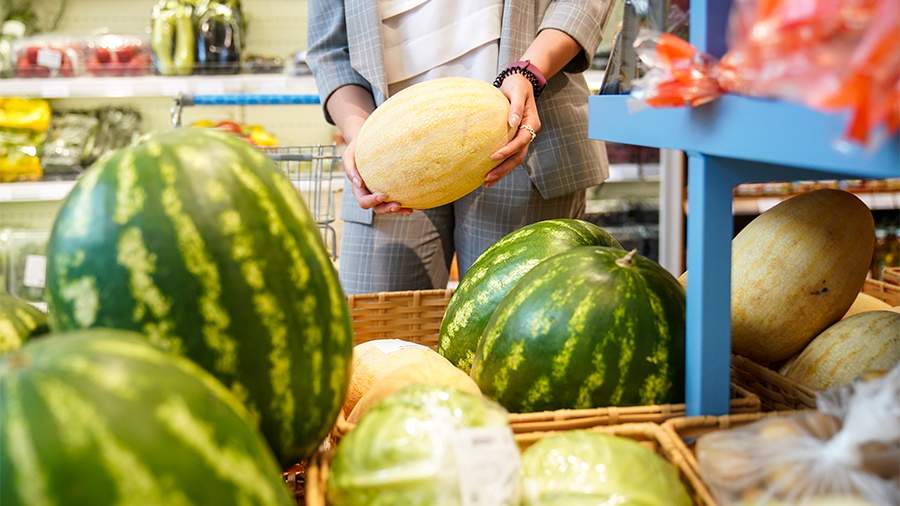
Summer is the season of ripe juicy watermelons and melons. According to last year's research by X5's Package service, 47% of Russians love both fruits, but 35% would still prefer watermelon to melon. The nutritionist of the service, Elena Sviridova, told Izvestia on July 18 how to choose these products correctly.
"One of the main and simplest life hacks is to pay attention to the sound when tapping on the peel. In the case of watermelon, it should be sonorous, but with melon, on the contrary, it should be deaf. To determine for sure what you have heard, try to apply this method to several fruits and choose the most suitable one in comparison," the expert explained.
In addition, the eyes involuntarily fall on the brightest fruit, but this approach can spoil the taste experience. First, check the peel for cracks and damage. Secondly, contrary to misconceptions, watermelon should not shine, and this indicates its immaturity. And when choosing a melon, take a closer look at the tail — the ripe fruit will already have dried.
Another way to choose a juicy fruit is to listen to the aroma. To check the watermelon using this method, you need to lightly scratch the peel. If there is a grassy smell, the berry is already ripe. If this cannot be done at all, it means that the fruit has not yet ripened. Melon, in turn, should not emit such a fragrance.
"It is equally important to pay attention to the average market value of the fruit. If you see a watermelon or melon at a lower price, it may indicate that the fruit is already overripe, so it should be sold soon to preserve freshness. In 2025, the average cost of a watermelon is 100 rubles per 1 kg, and a melon is 220 rubles. To make sure that the fruits are fresh, shop in reliable places — in trusted markets, as well as in chain supermarkets," she said.
Dmitry Morkovkin, an associate professor at the Financial University under the Government of the Russian Federation, and an economist, warned on July 2 that early watermelons could be dangerous to health, as some Russian farmers abuse various fertilizers for their growth. According to him, safe Russian watermelons appear in late July and early August, and early specimens are considered not very useful due to the use of accelerated cultivation technologies using growth stimulants.
Переведено сервисом «Яндекс Переводчик»
