
The Korean Wave: how North Korean citizens live outside Pyongyang
New buildings painted in bright colors, minimal advertising, and very monotonous but by no means uniform clothing of local residents — the Izvestia correspondent visited the capital of one of the provinces of the DPRK, the resort city of Wonsan. At the end of June, a modern tourist complex "Wonsan-Kalma" was opened there, where guests from Russia are already vacationing. What the once provincial city looks like, turned into a showcase for foreign tourists, is in our report.
The resort on the site of the airbase
Most reports or books about North Korea describe its capital, Pyongyang, in one way or another, because that's where visitors to this very closed country most often end up. The Izvestia correspondent had a unique opportunity to look at life outside the capital of the Democratic People's Republic of Korea.

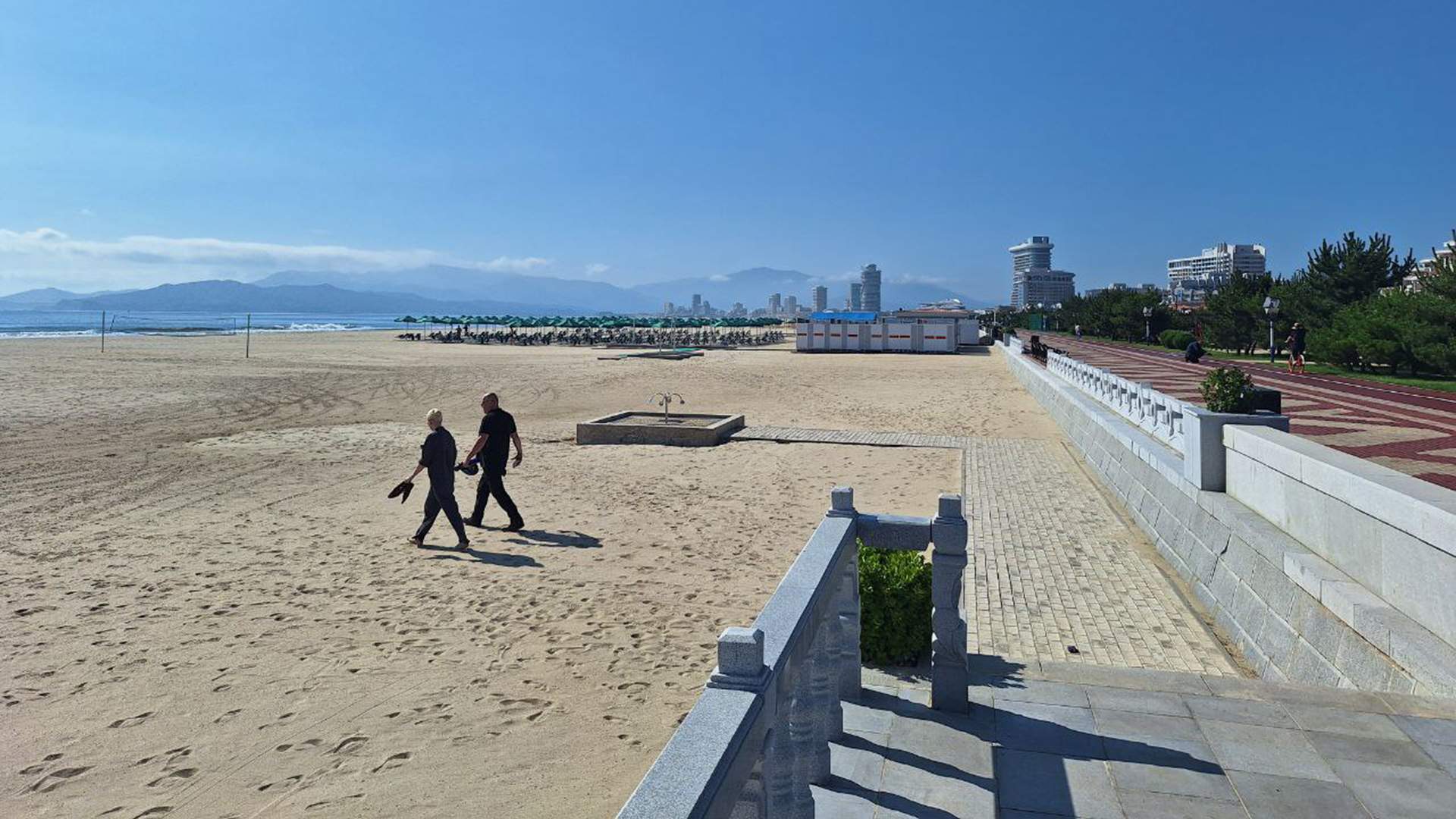
Wonsan is a coastal port and industrial city with a population of about 360,000 people. This is the latest data for 2008, and then it ranked fifth in the country in terms of the number of inhabitants. In 2018, construction began next to it, and at the end of June 2025, the Wonsan Kalma resort was officially opened. Previously, there was an airbase in its place.
The first thing that catches your eye when driving through the streets is the bright colors of the houses. For example, several three—storey buildings (apparently residential) are painted blue, followed by green, then pink. According to local residents, the houses began to be painted after the beginning of the reign of the current leader of the DPRK, Kim Jong-un, previously the white color prevailed in the appearance of the city.

Among the colorful buildings, social institutions immediately stand out. For example, a school is surrounded by a powerful white fence, and a sign with the appropriate name hangs above the gate. A group of pioneers with badges on their chests stands next to the building (the Izvestia correspondent also became the owner of such a badge).
The number of floors varies from modest single-level buildings to fairly large six- or eight-story buildings. At the same time, many new buildings are visible, especially on the outskirts. Other observers have also noted the development of housing construction in the DPRK in recent years.

Many new buildings are already inhabited: curtains, pots of flowers, and other signs of life can be seen on the windows. There are signs of shops and institutions on the ground floors of some houses, but there are few of them. For example, we managed to notice a sign with an electronic currency exchange rate — apparently, a bank or an exchange office is located there.
There is practically no advertising, and a few posters and banners have an ideological orientation, but they are very visible. Slogans are found on the roofs of buildings or in front of them. Portraits of the leaders of the DPRK are, of course, installed on the city square.
The general appearance of the city pleasantly impresses with its absolute cleanliness: perfect fresh markings, whitewashed trees, literally cleaned streets to a shine. Traffic is controlled by traffic controllers in a beautiful snow-white uniform. However, cars were quite rare, although there are some in the parking lots. This is most likely due to fuel economy.
But there are a lot of cyclists on the way.
"Bicycles are mostly locally made, although there are also Chinese ones — they are more expensive," one of the local interlocutors told Izvestia.
Most cyclists are women, who most likely go shopping. This is indicated by the shopping baskets attached to the bike. They ride exclusively on sidewalks that are wide enough to accommodate pedestrians as well.

And there are a lot of the latter in the middle of a Saturday afternoon, which, by the way, is considered a working day in the DPRK. Someone is in a hurry about their business, someone is standing at a bus stop waiting for a bus. By the way, they look unusual: wooden structures with seats, but without a roof. Women and children cover themselves with umbrellas from the scorching sun, while men patiently endure the heat without any accessories.
Most of the men and women are wearing short-sleeved shirts and wide trousers. Black and gray colors prevail, and women sometimes wear white blouses. However, it cannot be said that the clothes are strictly unified. Periodically, you can meet people in a pink T-shirt or sneakers. But, of course, they are mostly young people.
How to relax in North Korea
Given the expected communication problems in North Korea, I was interested in the issue of communication. Judging by what I've seen, ordinary people have smartphones, and quite different ones at that. North Korea has developed a line of phones with its own operating system. The basic functionality is present: they have messengers and applications, among other things.
Almost all locals also have computers, one of the interlocutors assured Izvestia. They can be used to access the Intranet, a closed network that is separated from the global Internet. Based on open sources, employees of the Ministry of Foreign Affairs, law enforcement agencies, and some scientists have access to the global network.

Russian Foreign Minister Sergei Lavrov and North Korean Foreign Minister Choe Song-hee at a meeting in Wonsan, North Korea
North Koreans can also use the apps to read newspapers. For example, the website of the Central Telegraphic Agency of Korea was opened on the hotel screens with a photo from the meeting between Russian Foreign Minister Sergei Lavrov and Kim Jong-un, which took place in Wonsan.
According to the North Korean leader, he decided to meet there because the Russian foreign minister has recently been "very active in foreign policy," and in Wonsan he will be able to "have a little rest." Apparently, both politicians have a busy work schedule: after they shook hands and hugged each other, smiling, Lavrov joked that neither he nor Kim Jong-un had stopped smoking.
Locals also have a rest at the resort. For example, a group of teenagers splashed merrily in the sea, putting algae on their heads to protect them from the sun. But there aren't many people at the Wonsan resort yet. Perhaps this is due to the fact that it was recently opened. The beach is divided into 15 sections, while vacationers from the DPRK are concentrated on several of them. And foreigners are not allowed there: a local beach worker forbade me entry with signs. It is worth noting that there was not a single political poster on the territory of the resort.

Among the foreign tourists, a group of Russians from Moscow, Vladivostok and St. Petersburg came here. They are satisfied with the rest: they note the quality of the resort and the hospitality of the hosts. The cost of a standard tour is $1600-1800 per person. The authorities of the DPRK and the Russian Federation intend to promote the growth of tourist flow. For this purpose, the possibility of launching a ferry service from Vladivostok to Wonsan is being considered. Also, the foreign ministries will promote the development of relations between the regions of the two countries — then there will be more flights. Sergey Lavrov noted that the countries will also work on simplifying the visa regime. However, the ties should be bilateral, which means that in the future guests from North Korea may appear at Russian resorts.
Переведено сервисом «Яндекс Переводчик»
