
Beauty demands: Glampings ask for land amnesty
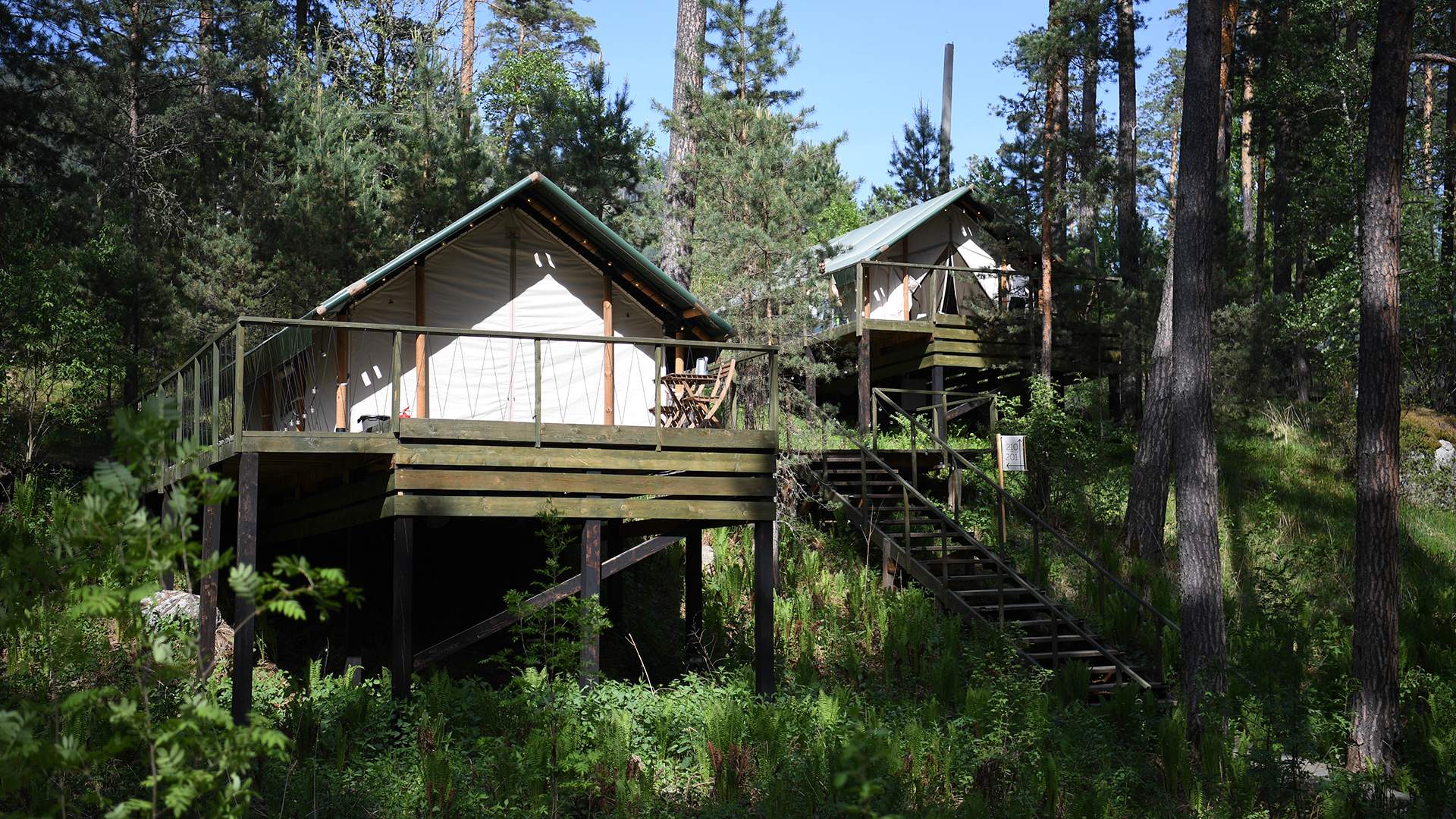
The Accounting Chamber conducted an audit of the use of federal budget funds, which were allocated as subsidies for the placement of glamping and camping sites. It turned out that about 40% of the implemented projects are located on land plots, the type of permitted use of which is not intended for these purposes at all: the objects are located on agricultural territories, on residential housing lands. One of the reasons why glamping sites are built in the wrong places is the lack of beautiful places where tourists are willing to go. However, the glamping community notes that for a long time there was no clarity at all where such structures could be built, and now they are asking for amnesty for already erected structures. Details can be found in the Izvestia article.
What the audit of the Accounting Chamber found
The Accounting Chamber checked the use of funds allocated in 2022-2024 for the creation of "modular non-capital accommodation facilities" under the federal project "Development of tourist Infrastructure" in three regions: the Republic of Buryatia, the Kabardino-Balkarian Republic, the Tver Region, and in general according to documents of the Ministry of Economic Development.
The report says that at the time of submitting applications for the selection of projects, 42% (77 out of 185) of the land plots did not provide for the placement of facilities providing temporary accommodation services for citizens. As of February 1, 2025, this share decreased slightly, but remained significant — 38% (71 out of 185). This means that six sites have converted the land to a permitted type of use.

However, the Accounting Chamber concluded that violations had been committed in the selection of projects for the creation of glamping and camping sites to which federal funds would be allocated, since in the constituent entities of the Russian Federation, projects are allowed to be implemented on individual housing (IHS) and agricultural lands. An example is the situation with the provision of subsidies to one of the companies in the Tver region. The project was supposed to be implemented on a site designated for residential housing.

There were certain problems with projects that are being implemented on the territory of specially protected natural areas. Cases from different regions are described here. Among them, for example, it was pointed out that it was impossible to change the ownership of land plots due to non-approval of the boundaries of protected areas, and investors refused to implement projects due to the inability to implement restrictive measures, which led to the termination of subsidy agreements.
Izvestia sent a request to the Ministry of Economic Development.
Where do glamping appear
Alexey Cherepakhin, founder and CEO of the Russian vacation rental booking service <url>, notes that the popularity of glamping and camping sites is constantly growing: in 2023, for example, the number of bookings increased by 155% compared to the previous year, and in the summer of 2025, the demand for this type of recreation has already increased by another 14%.
Eduard Demidov, Chairman of the hoteliers commission of the St. Petersburg branch of Opora Russia, notes that against the background of a sharp increase in the popularity of glamping, businesses are trying to occupy promising positions, sometimes neglecting legal aspects. He is sure that the share of glamping on lands not intended for them is actually higher than 42%.

— We are talking about a fairly new phenomenon, and the legislative framework does not always keep up with it. At the same time, many entrepreneurs, especially small ones, may simply not be aware of all the legal requirements. Or consciously take risks, hoping that their activities will go unnoticed," he told Izvestia. — And the definition of "permitted use" of a land plot is often the subject of "creative" interpretation on the ground.
Georgy Mokhov, Vice President of the Russian Union of Travel Industry (PCT) and founder of the Persona Grata law agency, is also confident that the figure is much higher, since the Accounting Chamber checks only subsidized projects. At the same time, many other facilities are being built with investors' money. According to Georgy Mokhov, 256 campsites and 1,553 recreation centers are currently registered in the unified register of objects classified in the tourism industry. Usually, glamping is in this category.

Pavel Kiryanov, an expert in the hotel business and founder of Ivanhoe glamping, emphasizes that this is a ubiquitous story, and cites the Altai Republic as an example, where, according to him, up to 90% of glamping sites can be located on agricultural land.
Zhanna Kira, President of the Glamping Association, notes that the situation with the placement of glamping sites on lands that are not intended for this type of activity varies from region to region: for example, on Lake Baikal, in the Moscow Region, Krasnodar Territory or Sochi, stricter regulation within the region in terms of VRI.
The owner of a country hotel in the Tver region, businessman Sergey Grishin, explaining why situations of improper use of land by glamping are common, notes that one of the problems in the implementation of such projects is the lack of beautiful places, and this is the key to business success. Georgy Mokhov says the same thing: many beautiful places are under various kinds of encumbrances in terms of land use — on agricultural lands, forest lands or residential housing.

Roman Sabirzhanov, founder of HotConsulting Management Company, which deals with analytics and hotel management, notes that there are few recreational areas with communications near tourist traffic, and competition for them raises the price of land to 25% of the project budget, which negates the price advantage of the modular format.
What do glamping owners see as a way out?
Sergey Grishin notes that in such situations, businessmen try to transfer their land to the right category.
— Without this, there is no way to get licenses to work with people, it is impossible to open a restaurant, reception, — says the interlocutor of Izvestia. — As a business, it is much harder to sell, as it is difficult to find a buyer.

At the same time, Sergey Grishin notes, it is most often possible to negotiate with regional authorities and ask for help in transferring land to the right destination — after all, this kind of business is generally viewed positively.
"Therefore, as soon as a businessman finds land for a hotel, he should first come to the local authorities and tell them about the benefits of glamping in this area, and learn about the possibility of changing the purpose of the land," he says.
Roman Sabirzhanov notes that the lack of VRI for glamping is becoming a serious business risk. The bank will not accept such an asset as collateral, and regional supervisors may threaten fines (up to 1% of the cadastral value). At the same time, the transfer of the site to "recreation" may require 6-12 months and documentation at the capital construction level. And Zhanna Kira notes that now the process of transferring land to another category can take up to several years. And there is no unified system in Russia that would speed up this process to two or three months.
At the same time, initially, when the market was just forming, there was no clear understanding of where it was possible and where it was impossible to build glamping, she continues. Now there is clarity, but some of the projects have already been implemented on lands of unsuitable type of permitted use.

— In this situation, the Glamping Association sees only one way — help and amnesty, — emphasizes Zhanna Kira. — An excellent example is the Altai Territory, which allowed its entrepreneurs to transfer land in three months.
Pavel Kiryanov notes that in the neighboring Altai Republic, agricultural land is the most liquid: for example, near picturesque rivers.
"But they don't graze cattle near rivers either: they can face heavy fines for this," he said. — And in general, all those places where hotels and glamping sites are being built are more suitable for this type of permitted activity. Therefore, a large amnesty is needed, under which the land under the facilities will be transferred to the status of recreational. It is unlikely that a hotel or glamping will be demolished and a farm will be built on this site and cattle grazing will begin.
Do glamping interfere with territories
Zhanna Kira is sure that glamping sites located on lands not intended for this purpose are not a problem for people living nearby and territories in general. According to her, this is an infrastructure for a very favorable target audience. Therefore, she calls the glamping land problem exclusively bureaucratic.
Georgy Mokhov also believes that glamping usually does not cause big problems for local residents: after all, they are built in deserted places. But for officials, this is a headache: they have to solve the problems of electricity supply, sewage disposal, garbage collection and nature restoration.

— In most cases, the problem is not in bureaucratic obstacles, but in conceptual errors when designing projects, when legal features and limitations are not taken into account, — Georgy Mokhov is sure. — In the euphoria of receiving subsidies, people enter the project without assessing the subsequent risks.

However, Eduard Demidov notes that glamping can still cause some harm: vegetation destruction, ecosystem disruption, and soil degradation are possible when it comes to agricultural land. And the discontent of local residents is possible: noise, garbage, increased traffic, violation of privacy, and sometimes disputes arise over access to water resources, beaches and other public places.
Переведено сервисом «Яндекс Переводчик»
