
Enemies all around: Poland is closing itself off from migrants
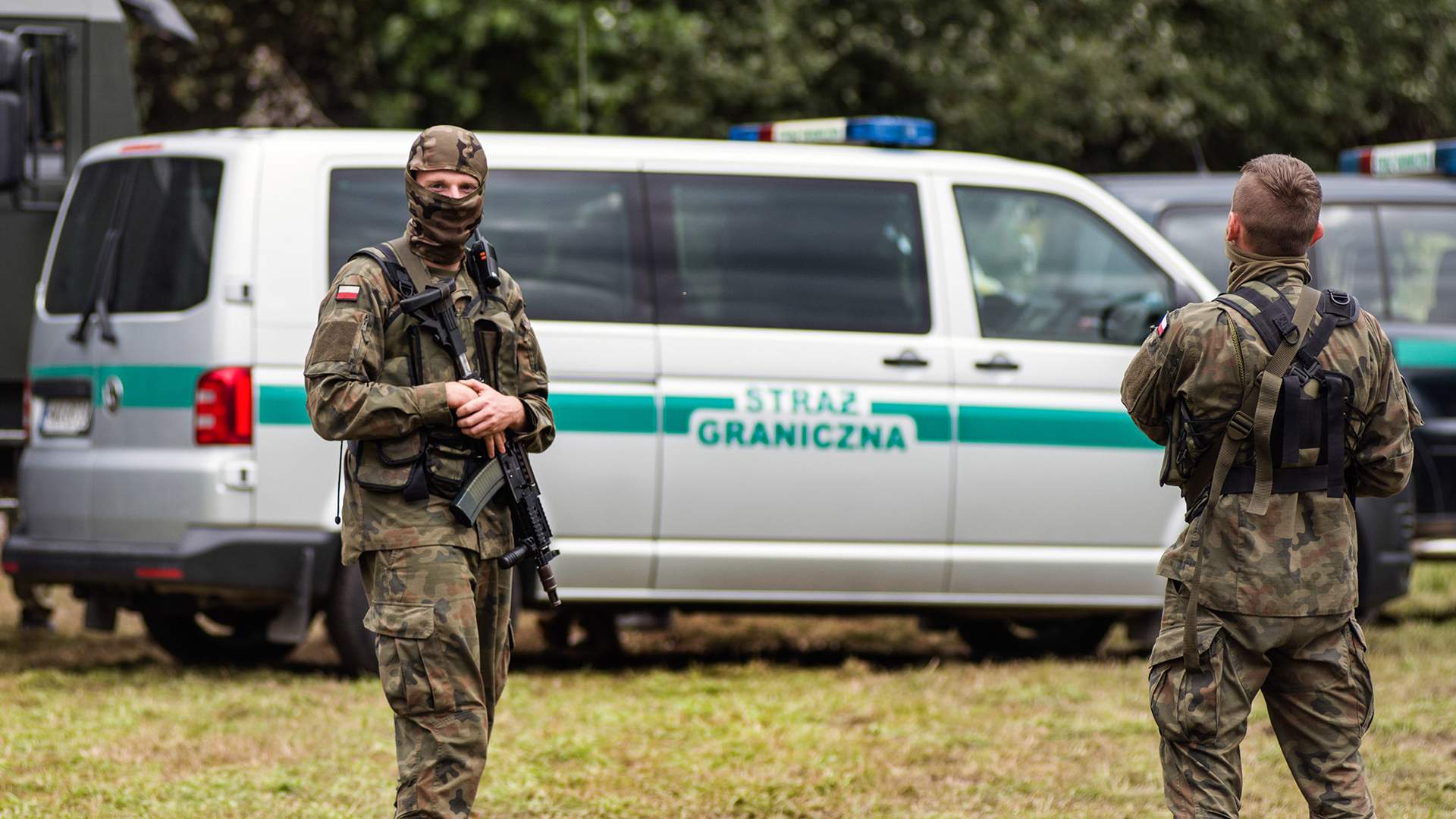
Poland has temporarily resumed 30-day border controls with Germany and Lithuania. As a reason, the authorities point to the need to tighten the fight against the flow of illegal migrants in the country. In this regard, the army launched Operation Safe West. Its task is to stabilize the situation on the border with Germany. For more information about the migration crisis in Poland, the reaction of the European Union (EU) countries to the actions of the republic's authorities, as well as possible consequences for Warsaw, see Izvestia.
Migration crisis in Poland: what is known
The other day, the head of the Polish Ministry of Defense, Vladislav Kosinyak—Kamysh, announced that the republic's army was launching Operation Safe West on the border with Germany. It should help the border service and the police in the fight against illegal migrants. The Minister of Defense announced the expansion of the Operation Safe Podlasie zone, launched in 2024 to control the Polish-Belarusian territory, to the border with Lithuania.
"Operation Safe West has begun — the Polish army supports border guards and police on the border with Germany. At the same time, we are expanding operations on the border with Lithuania as part of Operation Safe Podlasie," Kosinyak—Kamysh wrote on the social network X. He also added that up to 5,000 troops could be involved in the operation.
In early July, Polish Prime Minister Donald Tusk announced the introduction of a 30-day temporary border control with Germany and Lithuania until August 5, with the possibility of extending it. Warsaw made this decision in response to similar measures taken by Germany last year. During the first night, about 600 people and 400 cars were checked at the Polish-Lithuanian border, according to Radio ZET. The republic's border service said it had detained an Estonian courier who was trying to smuggle illegal migrants from Afghanistan to Poland.
At a press conference in the Netherlands on defense cooperation between The Hague and Warsaw, Donald Tusk said that the issue of illegal migration in Europe is particularly acute now. First of all, Poland is fighting the "Lukashenko regime." The Prime Minister said that the country has achieved success in the fight against illegal migration. "Despite the fact that not only smugglers, but also Belarusian special services are involved on this side, we have reduced illegal crossings on several hundred kilometers (of the border) by 98%. Practically no one can pass through the Polish barrier, thanks to the efforts, the gigantic efforts of the border guard soldiers. <...> And all this will be meaningless if the other external borders of the European Union are not protected in the same way," said Donald Tusk.
Currently, Poland, Lithuania and Latvia explain the border crisis by the flow of illegal migrants who allegedly seek to enter the EU from Russia and Belarus. Minsk, in turn, claims that the European Union unilaterally stopped the creation of temporary detention centers, as stipulated by the readmission agreement. Belarus does not intend to support refugees seeking to reunite with their families in Europe at its own expense.
The Polish Prime Minister also noted that "all border crossings on the border with Germany have become objects of critical infrastructure." Warsaw has closed the republic's borders to help EU countries deal with migrants. "This is not the kind of control that will make life difficult for people on both sides of the border. He will be very smart, very flexible. <...> We are doing this for you too: for the Germans, for the Dutch, for the French, because this border is the border of the European Union," Donald Tusk said at a recent press conference.
Political analyst Stanislav Stremidlovsky told Izvestia that the Tusk government had actually "shot itself in the foot" by allowing the migration agenda to become a decisive fact of Polish politics. According to the expert, on this basis, there is a possibility of a clash between the so-called "civilian patrols" organized by the far-right "Border Protection Movement" of Robert Bankevich and the police. Despite the fact that Polish law enforcement agencies should support the position of the authorities, which is by no means aimed at deporting refugees already living in the country, some citizens still oppose it. Earlier, the Polish Prime Minister described the activists as "militias" of the country's main opposition force, the conservative Law and Justice Party (PiS), as well as the right-wing nationalist Confederation.
— Now there is a very big problem with the cohesion of the current Polish ruling coalition. It consists of several parts, and they are already beginning to devour each other. And it was in this situation that Tusk admitted that the migration issue, the penetration of migrants from both Germany, the western border, and the eastern border, from Lithuania, became fuel for the opposition forces, the expert is sure.
How it all started
The Polish migration crisis on the borders with Belarus, Lithuania and Germany escalated dramatically a few years ago. In 2020, according to the border guard service, there were only 122 attempts to illegally cross the border, while a year later this number increased to almost 40 thousand.
In the summer of 2021, there were many migrants from the Middle East on the Polish-Belarusian border. Polish border guards did not let them in, using special equipment. Later, on August 28, Warsaw decided to install a fence — a 180-kilometer structure with a height of 5.5 meters, of which 5 meters is a steel part, and the remaining half a meter is barbed wire. The construction cost the Polish budget $370 million.
Last fall, Germany imposed temporary controls on all land borders for six months and intensified the refugee expulsion process. In response, Poland accused Germany of hostility and promised to take "retaliatory sanctions," saying that "friends and neighbors don't do that." When Friedrich Merz, a representative of the CDU/CSU, was elected chancellor in May 2025, tough measures to combat illegal migrants began to be implemented even more actively. These include the introduction of permanent border controls. According to some media reports, refugees have even begun to be taken out of the country to the Polish border in order to get rid of them. In response to Germany's actions in the field of "migration control," Polish President Andrzej Duda said that Warsaw "does not intend to solve the problem of illegal migrants outside Germany."
In 1995, Europe began the process of abolishing border controls between EU states, but in some cases countries have the opportunity to restore them. Some of them took advantage of this privilege during the coronavirus pandemic, as well as after the influx of migrants that began in 2015.
EU countries' reaction to border closures
Warsaw's actions caused an expected negative reaction from the authorities of Vilnius and Berlin. Lithuanian President Gitanas Nauseda has sharply commented on Poland's decision to introduce border controls. He noted that this step within the framework of the Schengen area indicates the growing migration difficulties in the European Union. The installation of border controls should be temporary, ensure quick results, and be canceled as soon as possible. Otherwise, it will be perceived as a "capitulation" to the existing "problem".
Berlin, in turn, expressed its full willingness to cooperate with neighboring Poland. German Interior Minister Alexander Dobrindt said that he had offered his Polish colleagues to jointly carry out border control. It was assumed that the border guards of both countries would work exclusively on the German side of the border. Poland reacted negatively to the Interior Minister's proposal. Defense Minister Vladislav Kosinyak-Kamysh said that "the minister from Germany should not indicate" what Warsaw should do in this situation.
In connection with the statement of the Polish politician, the German newspaper Suddeutsche Zeitung noted that "Poland's border control is a ridiculous demonstration of stubbornness. However, Warsaw's decision was preceded by an equally ridiculous theatrical production on the part of Germany. <...> Both governments allow nationalists to dictate the agenda, instead of looking for real solutions to the problem."
Until now, Poland considered Russia and Belarus to be the main "migration enemies". Now everything turns out to be different: the main threat, according to Stanislav Stremidlovsky, is becoming "friends" in the European Union and NATO. In this situation, the closure of the borders by the Tusk government is perceived by Vilnius and Berlin as something "unexpected and strange." As a result, according to the expert, Poland splits the EU and NATO, and also calls into question the status of the Schengen Agreement, concluded back in 1985 and recognized to facilitate passport and visa control for all EU citizens.
Consequences for Poland
On July 6, the Polish Prime Minister stressed that the restoration of border controls would be "temporary" and would be introduced solely for the purpose of limiting and reducing uncontrolled migration flows in both directions. "We understand that this decision will affect people's freedom of movement, but there is no other way," Donald Tusk said. According to the LRT portal, the head of the republic's Interior Ministry, Tomasz Semoniak, assured that the step taken by Warsaw was not directed against Lithuanian citizens.
By expanding the operation "Safe Podlasie" and adding the German "West" to it, the Tusk government has only made things worse. Many Poles travel to neighboring countries every day to work, and it is now almost impossible to do so due to queues at the border. Stanislav Stremidlovsky notes that the current Polish migration crisis, first of all, has no obvious causes. Illegal refugees have been in the EU for quite a long time, this is an acute problem for all countries of the Union. In this context, such a sharp emphasis on this issue becomes not very clear.
— To be honest, it's not entirely clear why Tusk suddenly decided to raise this issue now.: She's suicidal for him. First of all, non-migrants will be a problem for Poles. The problem will be the escalation of the eternal internal Polish war. And I would not rule out that maybe even this will end with the collapse of the current government, and Poles will have to go to early parliamentary elections this year," the expert is sure.
Thus, in the anniversary year for the Schengen Agreement, the concept of a "seamless" pan-European space is facing an obvious crisis. The introduction of borders on the territory of the European Union is allowed only in cases of "serious threat to public order or internal security." The authorities of the EU member states wanted to be hospitable, so they let literally everyone into the territory of the states. Now this trend is starting to fade, as Europe has realized past mistakes and is actively trying to correct them right now.
Dmitry Officer-Belsky, an expert at the Valdai Club and a senior researcher at IMEMO RAS, does not rule out that the actions taken by the Polish government may be caused by the situation with Ukrainian refugees and aimed at pushing positions within the EU.
— Probably, the Poles want to play a significant role in reforming the EU migration rules. Moreover, Donald Tusk, like few in Poland, knows the principles of European structures, as he was the head of the European Council in the past, the expert recalls.
Переведено сервисом «Яндекс Переводчик»
