"Everyone understands that Russia is one of the key countries in water sports"

The World Aquatics Championships are starting in Singapore, the first in several years, since 2019, at which Russia is represented by an almost full—fledged national team. In December, at the World Short Course Swimming Championships, the Russians won six gold medals, losing only to the United States. In Singapore, the program is more extensive. Synchronized swimmers are returning to the first major tournament since Olympic Tokyo. Synchronized swimming has been a hallmark of Russian sports for decades, a niche where our athletes won even when they came to the tournament.
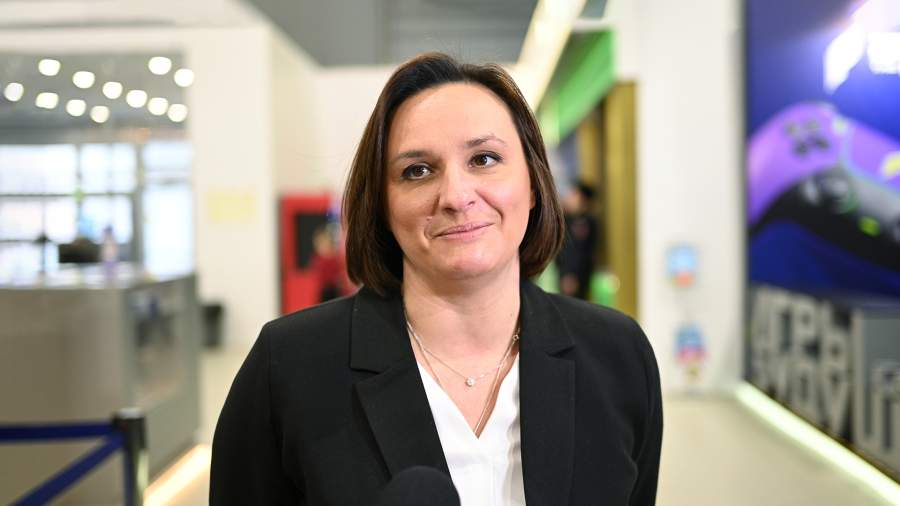
That's not the case right now, which is why the World Cup in Singapore is so important. Will Russia keep synchronized swimming as its patrimony? Olga Brusnikina, a three-time Olympic and four-time world champion, explained to Izvestia and Sport-Express why this task is especially difficult for Russians.
During our absence, the sport itself has changed
— Olga, there is very little time left before the start of the World Cup. What expectations do you and the national team have for him? Do we have a medal plan now?
— There is a medal plan, but I won't tell you about it. (Laughs.) I will say that we are going, of course, with the expectation of medals, but also with some caution and interest. In the three years that we have been gone, new Olympic and world champions have appeared. Therefore, it is not known how the judges will react to us, how they will evaluate us, I hope that everything will be fine. A lot of things have changed during our absence, in fact, the sport itself and its rules have changed. At the Russian competitions, we did everything necessary to adapt to these changes. And it seems to me that the quality of the programs of Russian synchronized swimmers has not decreased. At the World Championships, we will try to confirm the high level of Russian synchronized swimming.
— If you could schematically explain to an ignorant person what the essence of the rule changes is?
— Oh, actually, if you go into this, you can publish a whole separate article. But in short, now there is a technical set of elements, each of which has its own cost and which makes up a program with a certain complexity, expressed in numbers. And now everyone must submit a "coach's card" in advance for each program, which contains all the elements. Technical controllers of complexity monitor the fulfillment of everything stated, and technical controllers of synchronicity make allowances for each violation in synchronicity. There are also traditionally two teams of judges — the performance team and the artistic impression team, which evaluate the performance of elements and evaluate choreography, presentation style and many other components that affect the artistic impression. The most important thing for a coach right now is a strategic approach to setting up a program so that all the components that affect the result work as well as possible and the athletes can handle it.
— It's like figure skating, more math.
— Absolutely right. We are probably the last sport to adopt this system, following figure skating and rhythmic gymnastics.
— Alexander Maltsev said that these rules are playing against us.
"I wouldn't say that. Everything is on an equal footing, everyone adjusts themselves as best they can. I would even say that this reduces the bias factor that could arise in our case if we were returning to the old rules now. Because if you make a sufficiently complex program and manage to execute it, you will not fall below a certain level. Of course, I'm not satisfied with everything. There is a feeling that the balance between the various evaluation criteria — complexity, synchronicity, artistic component — has now gone rather to the technical side. But World Aquatics is trying to find this balance mathematically by using coefficients.
— Do you generally feel biased after returning?
— So far, we have performed only at one stage of the World Cup, and suddenly we were allowed to participate in the European Junior Championship. It's too early to talk about any kind of relationship yet. At the European Championships, for example, the Russians won six gold medals out of nine sets of medals. It is hardly possible to talk about bias here.
A lot of work is underway to get us into the competition.
— You said "unexpectedly" — do you have an explanation at all why the international federation is so loyal to ours in water sports? Many other sports are more difficult.
— I think everyone at World Aquatics understands that Russia is one of the key countries in the world in water sports, and without Russians, tournaments are not represented by all the strongest. And, of course, Dmitry Mazepin, the president of our federation, is making great efforts in this direction. He is in touch with the head of the international federation, and a lot of work is underway to make this possible.
— You also got a neutral status. Are you going to Singapore?
— Yes, I'm going to Penza after the Games, where I am now. I think it's going to be very hot in Singapore. In every sense. (Laughs.)
— Is it even possible to prepare for this? Or is it unprincipled for synchronized swimmers — +20 and a breeze behind the pool or +40 and crazy humidity?
— The main thing that can be done is to simulate the conditions that will be at the competition in preparation. That's why our athletes are currently training in Ulan-Ude. At least it's the same time zone. The most memorable thing in my career was the World Championships in Perth in 1998, when we won our first gold. We flew for a very long time, more than a day. We spent the night somewhere along the road, and acclimatization was difficult.
— You and Maria Kiselyova started winning 30 years ago. Do you think synchronized swimming can become popular someday or will it be a niche sport?
— It seems to me that it is already quite popular. The key to our popularity, of course, is the results, and they have been around for decades. But, of course, in recent years, interest in Russian sports has declined in principle for obvious reasons, it's not just about synchronized swimming. But even here, many athletes have decided to end their careers prematurely, seeing that there are no guarantees of returning to the international arena. The situation is improving now. And, probably, the growing popularity can be recognized by the fact that more schools are opening in the regions, new federations are being included. So synchronized swimming is on the rise.
The consolidation of federations has helped in terms of administrative resources
— How did you decide to start working in the federation?
— It's really a matter of chance. I can't say that I wanted to lead any federations, I was eager to go there. After her career, she became a coach, then decided to open a school in Chekhov in the Moscow region. People trusted me, and it reached the Federation of the Moscow Region. And somehow it turned out that now I am in this place, I was the president of the federation, after the merger I became the vice-president.
— Has the consolidation of the federations done anything?
— From the point of view of an administrative resource, yes, of course. We see an increase in interest in water sports, especially after returning to international competitions.
— In general, your family is just like that, a water sports family. My husband is from water polo, you are from synchronized swimming. Did one of the sons go swimming, or did he stop?
— Yes, we have a sports family, my husband, by the way, won the Russian championship this year as a coach of the women's water polo team. And the eldest son Ilya finished his sports career in water polo and eventually went to school. I have now enrolled in the first year of the Plekhanov Russian University of Economics. And I absolutely do not regret it. Sport is a very specific business that requires great sacrifices. In general, I do not think that children should be forced to do anything, including sports. Any person is talented in something. The child just needs to be given maximum opportunities so that he can be realized where he would like.
Переведено сервисом «Яндекс Переводчик»
