- Статьи
- Culture
- When Lennon was little: a letter from a young Beatle and the skeleton of a teenage dinosaur

When Lennon was little: a letter from a young Beatle and the skeleton of a teenage dinosaur

Lennon's letter complaining about McCartney's snoring, the skeleton of a young dinosaur, Galileo Galilei's literary debut, and Konstantin Somov's erotic book from Lidiya Ruslanova's collection. July is not the time for bidding on super—expensive paintings, as well as jewelry. However, this frees up space for lots of a different kind — from epistolary to natural science rarities. For the traditional monthly review, Izvestia chose the most interesting.
The first book by Galileo Galilei
In 1604, a previously unknown star flashed in the sky, visible to the naked eye better than Jupiter. In 1606, it was described in detail by Johannes Kepler, which gave the object the name Kepler's supernova. But a year before the publication of this work, another edition was published, which is a dialogue between two peasants discussing issues of astronomy and, ultimately, questioning the views that have existed since the time of Aristotle about the immutability of the heavens.
The author of the text argued primarily with Cesare Cremonini, a contemporary of the events described and a follower of Aristotle. An Italian scientist, a staunch adept of the ancient philosopher, regarded the supernova as an earthly phenomenon, because "if one star were added to the heavens, they would stop rotating."
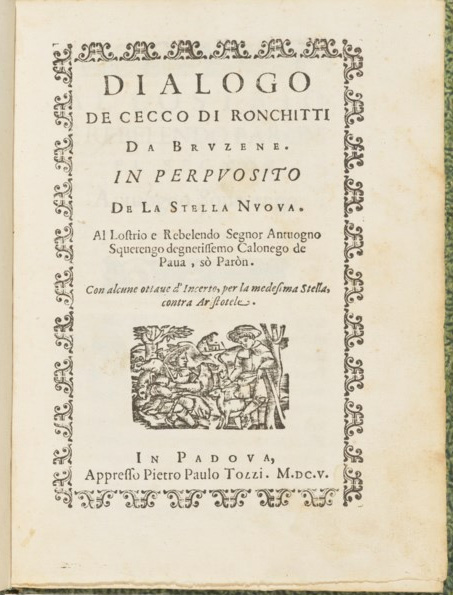
The book was published under the name Cecco di Ronchitti. Already in the 19th century, researchers agreed that Galileo Galilei was hiding behind a pseudonym, perhaps along with his student Girolamo Spinelli. And, therefore, this is the first published work (and even in an original literary form) by a man who would later become the main adept of the heliocentric system and, according to legend, would say the famous phrase "And yet it turns."
Only seven copies of the original complete edition of the book have survived to this day. Moreover, all the others belong to government organizations, and none other than this one is in private hands. Hence the impressive price of the lot put up by Christie's: 500-700 thousand pounds.

The Ceratosaurus skeleton
Dinosaur skeletons don't appear at auctions very often. But even more rarely, they are not adults, but cubs. One of these copies will be sold at Sotheby's as part of a natural history auction. We are talking about Ceratosaurus, an inhabitant of North America during the Late Jurassic period. In other words, this individual lived 149-154 million years ago! The scientific name of the animal is Ceratosaurus nasicornis, which translates as a horned lizard with a nasal horn. Indeed, a distinctive feature of the species is a large bone growth on the skull. Thanks to this trait, Ceratosaurus has become one of the most popular dinosaurs in popular culture.

Ceratosaurus skeleton exhibit
The skeleton of this predator was first discovered in the second half of the 19th century. They are mostly preserved in the Morrison formation, which covers a number of southern US states. The rarity put up for auction also comes from there. And this is a teenage dinosaur. His bones were recovered in 1996 in Wyoming, on a private property. In 2000, a museum in Utah became their owner, and he, in turn, sold the fossils to a company engaged in the "assembly" of the remains: only in 2024, an entire skeleton was assembled from individual fragments: a total of 139 original elements were supplemented with specially made missing parts, and all this is fixed on the frame. The result is a structure with a length of more than three meters and a height of more than two. The impressive exhibit, which allows you to imagine what a ceratosaurus looked like, is estimated at $4-6 million.
John Lennon's Letter
And the funniest item of the month: John Lennon's letter to his beloved Cynthia Powell, on display at Christie's, complaining about Paul McCartney's snoring. The message was written in April 1962 in Hamburg, when The Beatles were just beginning their rise to fame. In the newly opened Star-Club, the band (at that time, there was no Ringo Starr in it, Pete Best was sitting behind the drums) played under contract for seven weeks. As can be seen from the letter, Lennon was desperately missing his girlfriend at that time, was full of intimate fantasies and... suffered from the snoring of McCartney, who was sleeping on the bunk above Lennon.
By the way, Paul's name is mentioned in another connection. Cynthia, as can be seen from the letter, planned to live with McCartney's girlfriend Dot Ron, and John did not like this idea at all. "Imagine that she would be there all the time while we were in bed, and Paul would come all the time," laments the singer, who was 21 at the time.
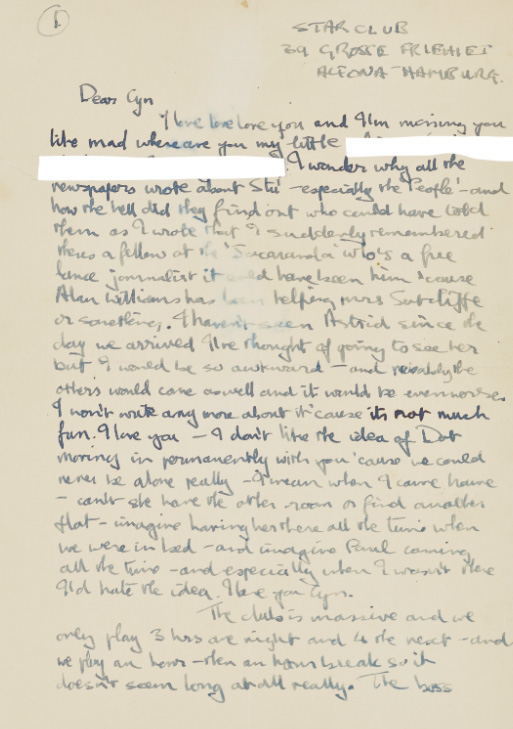
In August of the same year, John marries Cynthia, and their marriage lasts until 1968. She will keep the letter until 1991. But before selling it, Mrs. Lennon erased two phrases or sentences from it. What exactly was in them is a mystery.
The current owner bought the rarity in 1993 and is ready to part with it for 30 to 40 thousand pounds.
The erotic book by Konstantin Somov
Among the lots at the Russian auction in July, the "Marquise's Book" with drawings by Konstantin Somov, an outstanding artist of the Silver Age, attracts special attention. This is an anthology of frivolous French texts of the 18th century, originally published in 1907 in German with only eight illustrations and called the Little Marquise in the bibliophile community.
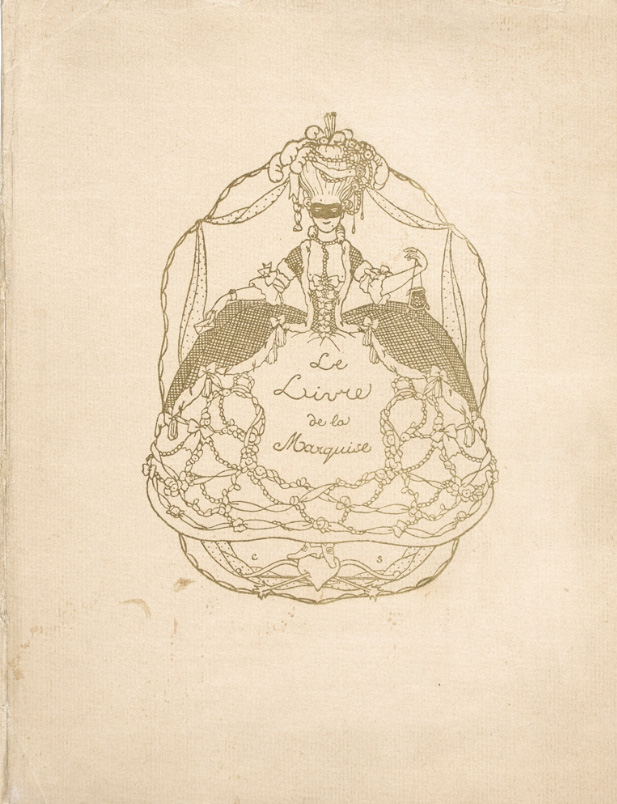
In 1918, the painter prepared two expanded versions in French, and he selected the texts himself and edited their translation. In one case, there were 24 pictures (respectively, "Medium Marquise"), in the other — 31 ("Large Marquise"). Moreover, the third option is the most daring. This applied not only to the seven added images, but also to some of the previously featured ones, which Somov made completely explicit.
Only 50 copies of the Bolshaya Marchesa were printed, and as conspiratorially as possible — even to the point that Venice was indicated as the city of publication (a hint at the unofficial name of St. Petersburg — Northern Venice). And for a long time, the owners tried to keep the possession of the book a secret. As it turned out, one of these bibliophiles was Lidia Ruslanova, a great Soviet singer. The publication, owned by her, was put up for auction by the 12th Chair auction house with a starting price of 1.5 million rubles.
Переведено сервисом «Яндекс Переводчик»
