The most important holiday on July 8 is Peter and Fevronia Day: the real story and miracles
- Новости
- Local news
- The most important holiday on July 8 is Peter and Fevronia Day: the real story and miracles

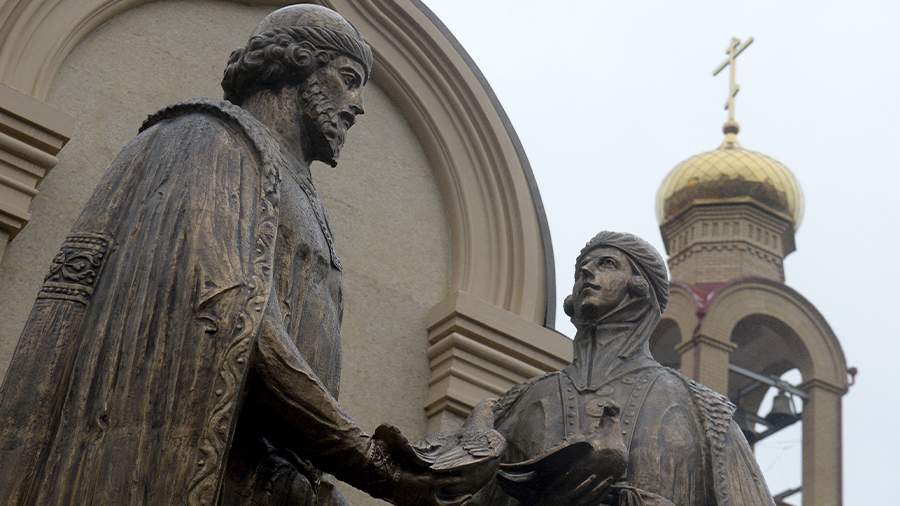
Every year on July 8, the Orthodox Church honors the memory of Peter and Fevronia of Murom, the heavenly patrons of marriage and family well—being. The story of their love, set forth in the work of Ermolai-Erasmus, became an example for many believers. A secular holiday is also celebrated on Saints' Memorial Day — the Day of Family, Love and Fidelity. Izvestia tells about the life of Peter and Fevronia.
The life of Peter and Fevronia: in what century, in what city did they live
The local veneration of Peter and Fevronia in Murom began as early as the 13th century, presumably shortly after the death of their spouses. The love story of the prince and the peasant woman became a national treasure, and the relics of the saints were kept in the main temple of the city — the Cathedral of the Nativity of the Virgin.
The Russian Orthodox Church canonized Peter and Fevronia in 1547. The creation of the lives of the saints was entrusted to the famous writer and publicist, priest Ermolai-Erasmus. Based on oral tales and legends, he wrote The Tale of Peter and Fevronia of Murom, which became a literary hit of its time. More than 200 lists of this story have come down to our days.
"The Story" stands out sharply from other church works due to the abundance of fairy-tale elements and romantic plot. At the same time, the question of the lifetime of its main characters is still open. Many researchers believe that their historical prototypes were Prince David Yurievich of Murom and his wife Euphrosyne. According to chronicle sources, Prince David ruled from 1205 to 1228 and shortly before his death took vows under the name Peter (in the story Peter also becomes a monk and receives the name David). There is practically no information about his wife.
Saints Peter and Fevronia: a true love story
According to legend, a pious prince named Pavel once ruled in Murom. One day, his family suffered a misfortune — a winged serpent began to come to his wife's chambers. To an outsider, he looked exactly like Pavel, and only the princess could see his true form. Being a wise woman, she did not hide what was happening from her husband.
The prince thought for a long time how to defeat the monster, and advised his wife to find out his weaknesses with the help of flattery. Finally, one evening, the snake, deceived by affectionate speeches, told the princess that he was destined to die from "Peter's shoulder, from Agrikov's sword."
Pavel had a brother named Peter. When he heard the prophecy, he immediately realized that it was about him. In the Murom church of the Exaltation of the Holy Cross, the young prince found Agrikov's sword and cut down the snake. However, the victory cost him dearly: the poisonous blood of the monster got on Peter's skin, and his whole body was covered with scabs.

The prince visited many doctors, but no one could help him. Meanwhile, the disease progressed, and Peter could no longer walk or ride. When he learned that there were skilled healers in Ryazan, he ordered him to be taken there.
In the village of Laskovo, Peter met Fevronia, the daughter of a collector of wild honey. The girl promised to cure her guest if he would marry her. The prince did not want to commit his life to a peasant woman, so he agreed only in words. After receiving healing, he went to Murom, and left rich gifts to his savior. On the way, the disease returned, and the disgraced Peter was forced to ask Fevronia for help again. After that, he still kept his promise and married the girl.
When Pavel died, the throne of Murom passed to Peter. However, the boyars did not want to see a commoner princess. They tried to expose Fevronia for inappropriate behavior, and then openly demanded that she leave Murom, otherwise Peter would not be an autocrat. The prince did not violate the sacred purity of marriage and, together with his wife, went into self-imposed exile.
Soon after, turmoil engulfed Moore as the boyars, blinded by greed, began a bloody struggle for power. The surviving nobles found the princely couple and asked them to stop the civil strife. So Peter and Fevronia returned to their city.
How Peter and Fevronia died, where they are buried
For many years, Peter and Fevronia ruled Murom in peace and harmony. At an advanced age, they retired to different monasteries, taking vows under the names David and Euphrosyne. The couple prayed to God to give them death on the same day and bequeathed them to be buried in one coffin with a thin partition. According to legend, the saints died on July 8 (June 25, Old style).
After the death of Peter and Fevronia, the inhabitants of Murom decided to disregard their last will, explaining that it was not appropriate for monks to be buried together. But the next morning, the bodies of the saints disappeared, and they were found in the very coffin that the couple had prepared for themselves during their lifetime. When the miracle happened again, the monks nevertheless put Peter and Fevronia in the same coffin.

Since the 15th century, the relics of saints have been kept in the Theotokos-Rozhdestvensky Cathedral of Murom. In 1553, Ivan the Terrible, in honor of the capture of Kazan, allocated funds for the restoration of the cathedral and the construction of three more stone temples. After the establishment of Soviet power in 1919, the temple was closed, and the shrine with the relics of Peter and Fevronia was opened. Subsequently, the relics were transferred to the anti-religious museum.
The veneration of the holy spouses resumed in the 1990s. Since 1992, their relics have been available for worship again. They are currently in the Holy Trinity Monastery in Murom.
The Miracles of Peter and Fevronia
In the Tale of Peter and Fevronia of Murom, in addition to the healing of the prince from ulcers and the reunion of the saints after death, many miracles are described. So, wanting to defame Fevronia, the boyars told Peter that after a meal she collects crumbs in her palm "like she's hungry." The prince decided to test his wife and invited her to dine at the same table. When he saw that the girl was really collecting crumbs, he grabbed her hand — fragrant incense and incense appeared on Fevronia's palm. From that day on, Peter no longer doubted his wife.
After leaving Murom, the princely couple set off down the Oka River. There was a married couple on the ship where Fevronia sailed. Tempted by a demon, the man desired the princess, but she immediately guessed his thoughts. She invited her companion to take turns scooping up water from one side and the other and drinking. Then the saint asked if the water tasted the same. The man admitted that there was no difference, and in response he heard: "So the female nature is the same. Why do you forget about your wife and think about someone else's?" After that, he didn't dare indulge in vicious thoughts.
Another miracle happened when Peter and Fevronia stopped for the night. The cook stuck wooden stakes into the ground to hang the cauldron on them. When the princess saw these stumps, she blessed them to become beautiful trees. The next morning, two tall trees appeared near the parking lot.
Today, Peter and Fevronia are revered as patrons of marriage. They pray for a happy marriage, the birth of children and peace in the family. They are also approached with requests for the recovery of loved ones and the healing of serious illnesses. Many couples seek to marry on Saints' Memorial Day or hold a wedding in a church dedicated to them.
Earlier, Izvestia shared postcards and congratulations on Peter and Fevronia Day.
Переведено сервисом «Яндекс Переводчик»
