
"I was offered to play a concert at the North Pole"
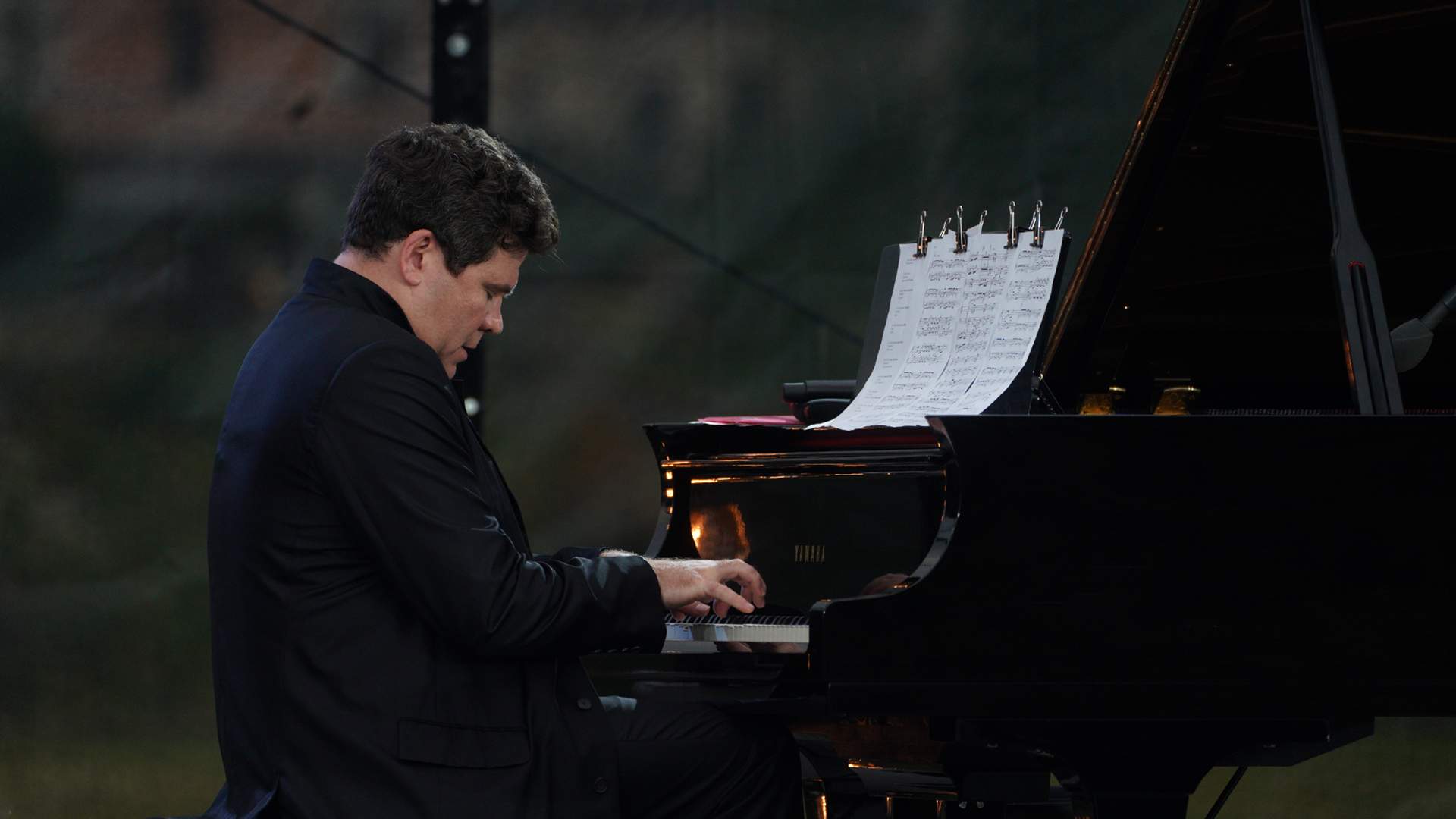
Pianist Denis Matsuev has scheduled 284 concerts for 2025. And I am ready to play even at the North Pole — on an icebreaker, from which the broadcast will be broadcast. But he considers it a real happiness to go on stage and perform in front of an audience. The People's Artist of Russia told Izvestia about this on the eve of his 50th birthday and the closing of the White Lilac Festival in Kazan, which coincided with the musician's birthday.
"To sit down and talk about what I have achieved over the years will no longer be Matsuev"
— At the White Lilac Festival, you played together with the State Academic Symphony Orchestra of the Republic of Tatarstan and its artistic director Alexander Sladkovsky the Fifth Piano Concerto with the Beethoven Orchestra. Why him and not Rachmaninov, after whom the festival is named?
— I wanted to perform a piece that appeared in my repertoire quite recently. I've been getting close to it for a long time, I started learning it with my dad. Unfortunately, he did not live to see the premiere — he died this year. As for Rachmaninoff's concertos, we have played them many times with my favorite orchestra of Tatarstan and Alexander Sladkovsky. Moreover, Sladkovsky is the first conductor with whom we played all of Rachmaninoff's concertos in a row in one evening. It was a year and a half ago in China. Probably, no one has ever done this before.
Both the orchestra and the maestro are my friends, my colleagues, and like—minded people. I can see what a peak they've climbed over the years. I am happy that I was an accomplice and witness of this ascent. By the way, we came up with the festival together with Sladkovsky many years ago and even brought Rachmaninov's grandson, Alexander Borisovich, here.

— How do you perceive your anniversary? Do you feel that you have passed a certain stage, are you summing up the interim results?
— I don't like the word "results" very much. Naturally, there can be no results now, because I'm living at the same pace of matsuissimo as before, and I'm not going to stop. In total, I have about 90 different concert programs — with orchestra, solo, chamber, jazz.But to sit down and talk about what I've achieved over the years.… It won't be Matsuev anymore, but some other musician.
— The second International Competition named after him will start in a few days. Rachmaninoff, of which you are the artistic director. What are your expectations? Will the geography of participants be expanded compared to last year?
— Yes, it has expanded significantly. And it turned out naturally, no one set such a task. Each member of the jury, while voting, did not know who his colleagues voted for. We had video samples, and recordings were sent from all over the world. In my opinion, the conductors alone had more than 200 applications. What does this mean? The fact that Rachmaninov's name is beyond borders. He is an icon for millions of people all over the world. Rachmaninoff is played every day, as is Tchaikovsky. So we are waiting for a huge invasion (in a good way) of amazing young musicians from 18 countries. From America, Europe, Asia…And we are waiting for the discovery of new names. The participants of the first competition — even those who did not pass the finals — have firmly established themselves on the philharmonic stages not only of our country, but also of the whole world.

Rachmaninov International Piano, Composer and Conductor Competition in 2022
— Yes, you have a busy summer.
— That's not all! I can't help but mention my new brainchild, which will be held in Suzdal from June 29 to July 5: the summer festival at the Museum-Reserve. This is the place of residence of our foundation "New Names". Since 1993, we have organized a summer creative school there every year, where master classes are held with famous professors. And now we have decided to hold a big multi-day open air.
I can say that there are simply no other summer festivals with such a rich program and the presence of such outstanding bands. GASO named after him will perform.Svetlanova, the Russian National Youth Symphony Orchestra, Valery Gergiev, Alexander Sladkovsky, Aida Garifullina, Ildar Abdrazakov, winners of Rachmaninov and Tchaikovsky competitions, famous students of the New Names Foundation from different years... There will be big gala concerts, chamber music, and jazz evenings. In general, everything will be boiling and bubbling during the week. A lot of people are waiting for this event, there are practically no tickets left a month before the start.

— Are you planning a new tour or some special event for your anniversary?
— My tour has not stopped for 30 years. I had my first big tour in 1994, four years before the Tchaikovsky Competition (where Denis Matsuev took first place, Izvestia). This year I have 284 concerts in Russia and abroad. I'm not going to do or change anything specifically for the anniversary. Everything is already so organic here!

"This generation manages everything. It's versatile"
— Has the geography of your tours changed compared to a few years ago?
— Yes, of course, the Eastern and South American directions are developing very powerfully now. But there are still concerts in some European countries. In addition, every year, the New Names Foundation team and I travel to at least 30 regions of Russia in search of young talented musicians.
— And what are your impressions of the youth?
— I think that this is a national treasure! Many of them are ready—made artists. Precocious, bright representatives of the Russian performing school. I believe in them. Amazing guys! Sometimes you don't even understand how they manage to exist in this time frame. This generation manages everything. It's versatile. Children not only play musical instruments, but also go to theaters and to symphony concerts.… Their command of foreign languages and computer technologies is amazing, and they have an amazing sense of humor!
— And smartphones, social networks, tiktoks — don't they interfere with their development as professionals?
— You know, the guys are so organically integrated into this modern environment that they are well aware of all its risks and features. There are benefits from social media, too. And if we're talking about so—called entertainment content, they understand that it's nonsense, idiocy that keeps coming up...

— But they will have to exist and compete in this environment in the future.
— We understand that we cannot compete with mass art. Although it cannot be called art. The problem is that there is little talent in this content. But there are also not enough bright names of young composers in the academic environment. That's why we're also doing a compositional discipline at the Rachmaninov Competition? We need new authors. There is an opinion that we ended up with Shostakovich in the composition. Admittedly, this is a reasonable consideration. I can even judge by the repertoire for the piano: yes, there are talented works, but there is no such thing that you immediately want to run to learn it. But I'm still an optimist in this regard. Because it can't happen that the music ends overnight. We are waiting for new discoveries.

— But so far you don't see any modern piano pieces that you would like to include in your repertoire?
— You see, I don't have a Schumann concerto, Chopin's First Concerto, Bartok's Third Concerto, or many Mozart concertos in my repertoire yet... I want to learn this for now. But it happens that you suddenly hear something brilliant, and you realize that you definitely have to play. This happened, for example, with a concert by Krzysztof Penderecki, a great composer who, unfortunately, died five years ago. I can also mention Rodion Konstantinovich Shchedrin — fortunately, he is alive (God grant him good health!), we are constantly in touch, we maintain relations. I have played two of his piano concertos, they are firmly in my repertoire. This is also modern music, although it is already a classic.

Concert at the Moscow Philharmonic
There are wonderful composers among the young ones. But I'm still waiting for this piano concerto that I want to play myself.
— In the meantime, you're playing Tchaikovsky's First Concerto over and over again. Don't you get bored with it?
— A work of genius cannot get boring. He might get tired of you. I've played Tchaikovsky's First Concerto probably four hundred times. For the first time, as a little boy, at home in Irkutsk, for grandparents and guests. I learned it by ear, picked it up. By the way, he was a great success. After that, Dad said, maybe we should look at the sheet music. What if there are differences? We looked at it, and indeed, there were differences (laughs). But on the whole, I got the motive right. A year later, I was already playing it with the orchestra in Irkutsk — and I was the happiest person.
"I was so unwell that I just wanted to run away from the stage!"
— A few years ago, your and Valery Gergiev's recording of this concert was performed at the Olympic Games during the awarding ceremony for Russian athletes.
— Yes, it was an accurate decision. Naturally, everyone understood that our athletes were coming out, because Tchaikovsky means Russia. But even such a brilliant concert cannot replace the real anthem, which we were deprived of — I think this decision is just some kind of nonsense and insanity! Therefore, I hope that someday we will return with the anthem.

Denis Matsuev and conductor Valery Gergiev at the Tchaikovsky Concert Hall
— Doesn't the sharpness and freshness of music perception get lost when you play it over and over again? And doesn't going on stage almost every other evening turn into a routine?
— For me, going on stage is pure happiness. When people ask me what you would like to do in 20 years, I say: to be on stage and play Rachmaninoff's Third Concerto. Like Tchaikovsky's Concerto, I've performed it hundreds of times too. This is the leitmotif of my life and is still an indicator of form: technical, spiritual. But all this makes real sense only during a live meeting with the public.
A long time ago, I was offered, for the sake of experiment, to make my hologram, to put on a Yamaha disc keyboard (a "self-playing" piano that can accurately reproduce the pianist's playing. — Izvestia), and outwardly it will look like I'm really performing now. So, I am sure that it is impossible to replace the lively perception of a live musician. For the sake of these real impressions, everything happens.

— What about the broadcasts, which are becoming more popular and in demand?
— I will never forget my concert in the empty hall of the Moscow Philharmonic, which we did in the spring of 2020, after the outbreak of the pandemic. The broadcast was watched live by several million people — for the first time in my practice. And I was so unwell that I just wanted to run away from the stage! Drop everything and leave! I felt that the energy, the cycle of emotions, for which I am giving a concert, is not here. I was playing Tchaikovsky's The Four Seasons, and it wasn't until the middle of the cycle—"May" or "June"—that I more or less came to my senses. It was one of the most difficult performances of my life. And after that, I said, God forbid that this should become our future.

The pianist, when playing on stage, sits sideways to the audience. But then I always meet with the audience, sign autographs, shake their hands and look into their eyes. It's an extremely important story to understand what happens to them after the concert. Even if the program had sad or even tragic music, there is still warmth and inner light in their gaze. That's the most important thing.
— Is the Russian audience different from the foreign audience?
— The Russian audience is the most difficult, but if you have a real big love with them... you know, all these festivals and contests all over the country are not just like that. This is the result of our great love. Especially in the Russian regions, which I absolutely adore. For me, trips to the countryside are valuable because they meet unique people who are not spoiled by the variety of concerts and perceive everything especially vividly. For the sake of such moments, I am ready to stay awake and play even more, because the greatest happiness is to feel the breath of the audience, to hear this understanding silence that illuminates you. And no matter what happens in this crazy world, you realize at such moments that there is always hope.
— Don't you get tired of the number of concerts?
— It's impossible to get tired of the number of concerts. You can get tired of flights and jet lag. But not from the concert itself — on the contrary, it adds strength, hope and much, much more to you.
Mom recently recalled how we went to my first exam at the Irkutsk School of art, I just squeezed her hand terribly and jumped to the sky. I was so looking forward to going on stage now! Only the teachers were supposed to listen to me, but even then I imagined them as an audience, you know? This is a moment of happiness. The highlight of my day is a concert. And I'm a lucky person that I can do this almost every day.

Pianist Denis Matsuev (center) performs at the closing ceremony of the XXII Winter Olympic Games in Sochi
— Do you have any kind of ritual ahead of the performance?
— When I hold the Stars on Baikal festival in Irkutsk, on the day of the concert, we first steam in the sauna with all the guests, and then jump into Lake Baikal. I will never forget how the Israeli Philharmonic Orchestra and conductor Zubin Mehta came to visit us. They also took a plunge. The musicians understood that the energy, purity and depth (in every sense of the word) of Lake Baikal simply illuminated them. It's a phenomenal feeling! After diving into Lake Baikal, Zubin Mehta brilliantly conducted his concert. By the way, none of all the stars who have come to Irkutsk and sailed with me over the past 20 years have fallen ill!
— Do you have any kind of creative dream? Maybe you want to play in some unusual place - on Everest, for example?
— I've been offered to play a concert at the North Pole.An icebreaker goes there every July or August, there is a technical possibility to take a piano with you and make a broadcast. It takes about ten days for the expedition.
— Well, wouldn't you agree?
"Why not?" Listen, I'm for all the fuss! I'm an easy-going person. There would be a piano and something to sit on.
Переведено сервисом «Яндекс Переводчик»
