- Статьи
- Science and technology
- The code of the Cross: scientists have revealed the details of the study of the Shroud of Turin

The code of the Cross: scientists have revealed the details of the study of the Shroud of Turin
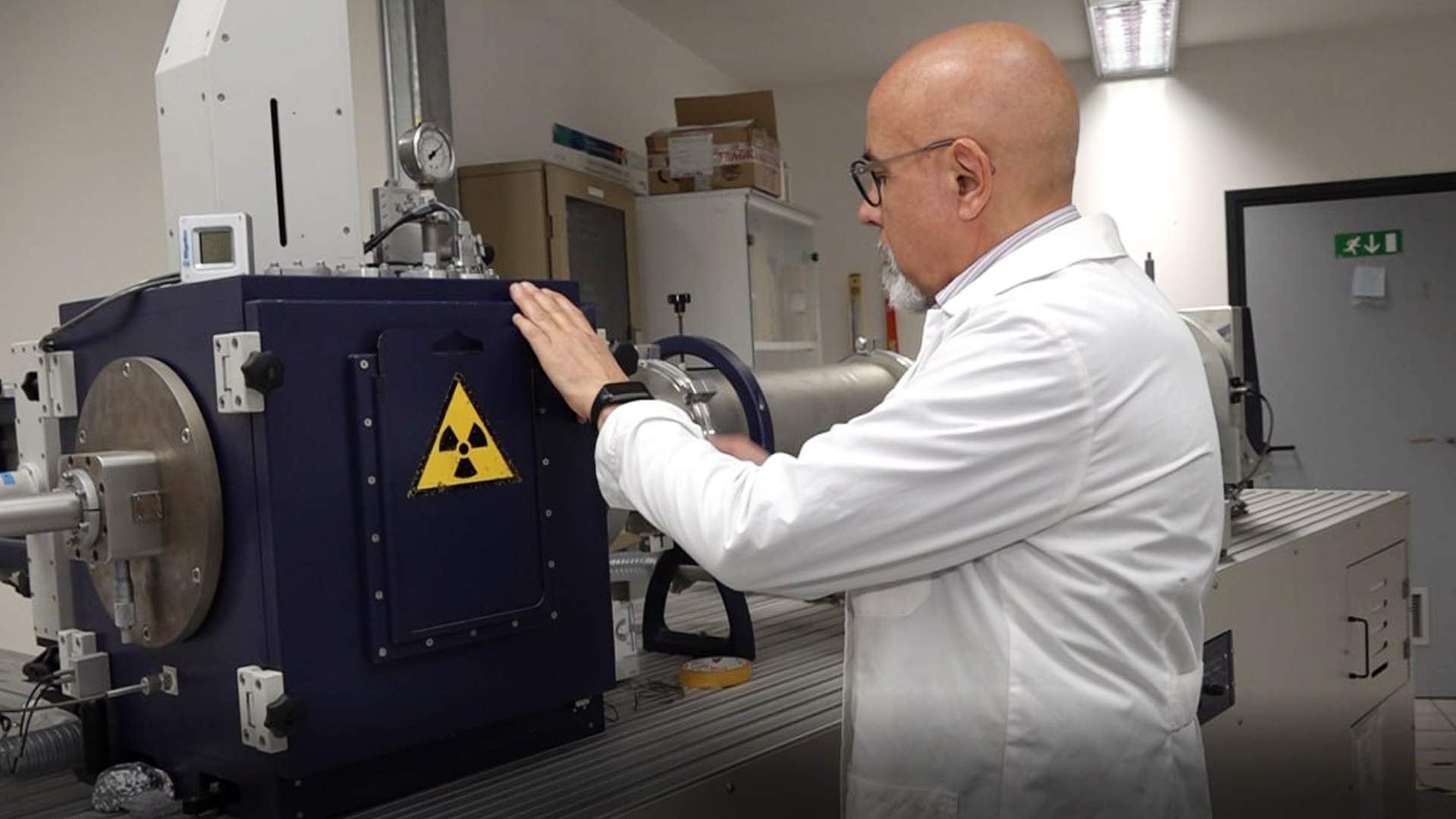
Scientists from the Institute of Crystallography of the National Research Council showed the Izvestia correspondent a laboratory where research is being conducted on one of the most important Christian relics, the Shroud of Turin. A new X-ray technique was used to examine the canvas in which the body of Jesus Christ was supposedly wrapped after the crucifixion. After conducting a series of experiments, the scientists concluded that the age of this shroud is more than 2 thousand years old. This has once again raised the debate about the authenticity of the artifact, both in scientific circles and among believers. Details can be found in the exclusive Izvestia article.
How to explore the Shroud of Turin
The laboratories that study one of the main Christian artifacts, the Shroud of Turin, are located in the city of Bari, famous for the Basilica of St. Nicholas, built in the 11th century. Last year, specialists from the Institute of Crystallography of the National Research Council published the results of a study of ancient tissue, which they conducted using the latest equipment. And the debate about the authenticity of the shrine resumed.
Cinzia Giannini, director of the institute, showed the Izvestia correspondent a laboratory where data on small-angle and wide-angle X-ray scattering on tissue fibers were collected, as well as a generator.
— These rays are generated in this part. If you hear a noise, it's the sound of a rotating anode. A beam of electrons hits the anode and emits X-rays. Then these rays pass through three pinholes — one, the second and the third — and enter the chamber located here," Cinzia Giannini, director of the institute, told the Izvestia correspondent.
A sample of ancient tissue is placed in the chamber at a certain level, and a plastic detector that captures X-rays is installed next to it. Using the second detector, which is located at a distance of 2 m from the first, scientists register small-angle ray scattering.
By screening the fibers in this way, the scientists were able to identify the characteristic structural elements, their size and number, and indicated the age of the fibers. There are many methods that make it possible to analyze the order in matter, Liberato De Caro, a scientist at the Institute of Crystallography, told Izvestia.
— The human eye has a certain resolution — fractions of a millimeter. Then we have an optical microscope, as well as an electron microscope, which allows us to see the structure at the atomic level in very thin samples. We can distinguish details less than a billionth of a meter in size, which is really incredible. If we want to explore matter on an even deeper level, we can turn to X—ray crystallography," he noted.
The rays have the ability to penetrate into matter, like X-rays, and provide information about the structure at the atomic level. For example, the discovery of DNA was made possible by crystallography and X-rays, the scientist emphasized. Crystallography does not form a direct image of atoms, but reveals the waves they create.
— It can be compared to trying to measure the length of a floating snake without seeing it itself, but only the waves it produces. If the snake is long, it will create wider and more intense waves, and if it is short, the waves will be smaller," explained Liberato De Caro.
After conducting a series of experiments, the scientists concluded that the age of this shroud is more than 2 thousand years old. This result, obtained using a new X-ray technique, is of great importance, as it can be applied to all fabrics and textile samples of archaeological interest, he added.
— Our result refuted the results obtained in 1988 using carbon-14, which indicated that the Shroud of Turin dates back to the Middle Ages. This once again raised the question of the authenticity of the shrine," concluded De Caro.
The shroud of Jesus Christ is mentioned in all four Gospels. According to legend, after the resurrection of the Lord, the apostles kept it. The painting, which was first shown to believers in the 1350s, has been controversial and exciting for centuries. It is one of the most widely discussed Christian artifacts. Scientists from different countries have used all kinds of methods, including radiocarbon dating, spectroscopy, and computer modeling, to determine whether the sacred artifact is really a religious shrine or a fake made in the Middle Ages by talented hoaxers.
The controversy over the authenticity of the Shroud of Turin
The most famous experiments with the artifact were conducted in 1988. Three independent laboratories at once — Oxford and Arizona Universities, as well as the Federal Polytechnic Institute of Switzerland — received samples of the shroud in order to establish its age. To do this, they used radiocarbon dating. According to the research results of all three laboratories, the shroud was made no earlier than the 13th century. That is, it could not possibly relate to the time of Jesus Christ. However, this conclusion did not put an end to the issue, new controversies broke out, and the results of the scientists were severely criticized, primarily because the fabric of the shroud could have been exposed to outside influences, in particular, burned in a fire, which distorted the test results.
There are many unanswered questions about the sample's history in these studies, Evgeny Alexandrov, director of the NTI Center for Digital Materials Science: New Materials and Substances at the Bauman Moscow State Technical University, told Izvestia. For reliability, it is necessary to examine several samples from different parts of the tissue, which is equivalent to its damage and therefore unacceptable. In addition, the accuracy of the study strongly depends on the purity of the sample. Especially if the fabric has been repaired or has been contaminated.
— In historical research, they often resort to forensic research. However, all scientific methods have a certain accuracy, reliability and interpretability. Scientific methods are not always applicable in matters of faith, since religion relies on "absolutely reliable" information, which people believe without doubt. Therefore, scientific and historical disputes over the events of bygone years will never stop, and faith will remain unshakeable," the expert commented to Izvestia.
Is it possible to establish the authenticity of the Turin Shroud
The Shroud of Turin remains one of the most mysterious and revered Christian relics, the authenticity of which has been debated for a long time among scientists, theologians, and believers of the Catholic and Orthodox traditions. Official churches avoid direct statements about the authenticity of the shrine as the funeral veil of Christ, emphasized Olga Lysikova, Candidate of Historical Sciences, professor and head of the NTI Thinking Club at Saratov State Technical University named after Gagarin.
— The first documentary mention dates back to 1353 in France, when the knight Geoffrey de Charny presented the Shroud of Turin as a Christian shrine. There are traces of flagellation, a crown of thorns, wounds from nails and a spear, which is confirmed by the gospel description. It is premature to put a final point on the issue of its authenticity," she said.
The results obtained by scientists from the Institute of Crystallography of the National Research Council deserve special attention from specialists of a narrow profile who can conduct a similar examination and compare the data, the expert said.
In her opinion, radiocarbon dating, biological and chemical research, imaging technologies, AI and reconstruction are the most effective when working with such artifacts. Experts from many industries from different countries see the Shroud of Turin as an object of scientific research filled with deep meanings, Olga Lysikova concluded.
Yevgeny Rashkovsky, a religious scholar and chief researcher at the Library of Foreign Literature, told Izvestia that plant spores found only in Palestine were also found in the Shroud of Turin. According to him, the debate about the authenticity of such artifacts is not related to religion, as people do not worship these relics as such, but Christ.
Переведено сервисом «Яндекс Переводчик»
