Veterans told about the first day of the Great Patriotic War

Many of the survivors of the outbreak of the Great Patriotic War (WWII) were not themselves participants due to their age — in 1941 they were three or four years old. On the eve of the celebration of the 80th anniversary of the Victory in the Great Patriotic War, they shared with Izvestia their memories of how the war began and where they had to stay during the hostilities. One of the sections of the Izvestia News Center's special project "The Great Victory" is dedicated to the stories of the winners of Nazism.
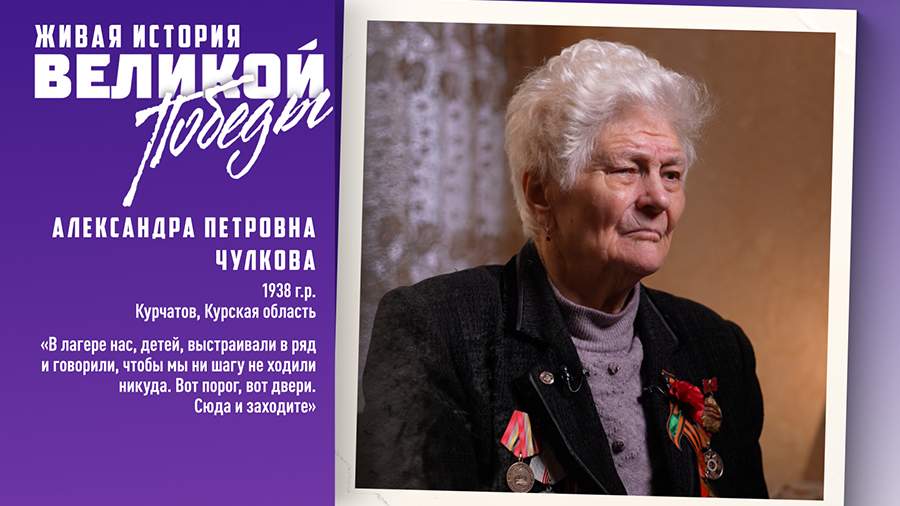
One of the narrators is Alexandra Petrovna Chulkova, born in 1938, from the city of Kurchatov, Kursk region. A former minor concentration camp prisoner was born in the Smolensk region. In 1941, she was only three years old.
"We lived in the village of Semichashino. One day, there was a sudden loud bang, and the chickens screamed behind our wall. And the cock crowed. The mother says, "Get ready, the war has begun," the veteran said.
The front was passing through their village, and residents were hiding from shelling in an abandoned house on the outskirts of the village. Soon the Germans entered the village, gathered everyone and drove them west. Alexandra's mother harnessed a horse to the cart and put the children there. At the same time, Alexandra's older brother was taken away by the Germans. They also tried to take the younger ones, but the woman did not give them back.
"Mother harnessed the horse to the cart and put us there. It was already cold. My fingers are frostbitten on my feet, even though my mother wrapped towels around them. <...> Mom was screaming: "No, don't touch it! I'll beat you all up if you touch my children!" says Alexandra Petrovna.
After that, everyone was taken to a concentration camp in Western Belarus, which was located behind high barbed wire. They settled in a barrack with two or three-story bunks. When they started to let them out, the children saw that dead Russian soldiers in helmets and overcoats were lying by the fence.
Alexandra's mother was sent to forced labor by the Germans. The children were allowed to go out to the nearest villages to feed themselves. The German soldiers had fun throwing biscuits to the hungry guys and watching them pounce on them. After the liberation, the family returned to their native village, which was completely destroyed. At first, they lived in a dugout, which was built on the site of a deep bomb crater.
"In the spring, we walked through the fields, picking frozen potatoes after the winter. It was like rubber. They baked tortillas from it, called them "nausea". We went around the villages, begging for bread. There was only one thought — to bring at least a little bit home, to feed my brother. I wanted to eat so much, I thought I'd never get enough," the former prisoner recalls.
Soon the funeral came for my father — he died while crossing the Dnieper. They learned about the victory on the radio — the loudspeakers were hanging right on the poles in the street. Music was playing all over the village, everyone was crying, laughing, rejoicing. After that, life began to get better and Alexandra, who was already in her seventh year, went to school three kilometers from the village. The recreated collective farm helped to build new housing.
Another witness of the war is Gerda Antonovna Pekni, born in 1936. She currently lives in Austria, in Vienna. Gerda Antonovna was born in Leningrad, into a family of Austrian anti-fascists. Her father first emigrated to the USSR, and then her mother, and they got married in Leningrad. My father worked at the printing house "Pechatny Dvor" named after Gorky. As Gerda Antonovna recalls, there was even a sign on their house that an Austrian who came to work in the Soviet Union lived in it. Gerda's strongest childhood memory is the Leningrad basements, where they hid from Nazi raids.
"During the war, I was in basements many times. Everyone was hiding in them from the shelling. The Russians always reassured me and supported me in every possible way," she recalls.
She also remembered how, during the hungry months, her father went out to the grocery store, and everyone was waiting for him to return. After that, Mom would come downstairs and help with the shopping. Gerda Pekni met the victory in an orphanage in Ivanovo, where she was evacuated along the "Road of Life". After the end of the war, her parents returned to Austria, but she carried her love for Russia through her whole life. After the war, my father was invited to the USSR Embassy in Austria to present the order for his work in Leningrad during the siege. My mother worked as a translator from Russian throughout the post-war years.
When Gerda Antonovna's granddaughter grew up, she brought her to Leningrad to show her the house in which she lived during the siege.
"I've told my husband many times.: "I can hear the bombs falling. That's horrible. For me, any war is a horror," concluded Pekni.
For Hrant Meliksetovich Karapetyan, born in 1923, a resident of Yerevan, the day of the outbreak of war on June 22, 1941, was the day after the school graduation. He was boating with friends on the lake when they were informed of the outbreak of war.
"The whole group of us went to the military enlistment office, we said: "We are going to war, take us to the army." The military commissar, of course, sent us away — do not interfere, they say, to work, and it will be your turn," the veteran recalls.
In August 1941, Grant was selected for the military aviation school in Tbilisi. Of the 70 students, only 30 were accepted, including himself. Immediately after enrollment, everyone was sent home "until further notice" — until they turned 18. But Karapetyan did not succeed in learning to be a pilot — in January 1942, the school was disbanded, and its cadets were sent to the Baku Infantry School. In August 1942, Grant Meliksetovich graduated from it and joined the units of the Transcaucasian Front, after which he became part of the 4th Ukrainian Front, commanded a machine-gun platoon.
The veteran received his first Order of the Red Star for fighting on the Sandomierz bridgehead on the Vistula River in August 1944. It was his capture that allowed the Red Army to develop an offensive in Poland and enter German territory. According to Karapetyan, he was on the verge of death seven times during the war, but escaped it.
"There was a case: We were advancing. The projectile snorts, whizzes by, and sparkles. Me and the platoon commander lay down. The shell fell between us, did not explode. If it had exploded, we would both have gone up in the air," Hrant Meliksetovich recalled.
Another time, they even issued a funeral for him, thinking that the soldier had died during a mortar attack. But later they found 7-8 people out of 35-37 who were in the platoon among the survivors. Karapetyan fought his way from Kiev to Prague, where he was slightly wounded on April 28, 1945.
"One morning in the hospital, someone knocks loudly on the door of the ward. We jumped up. My first thought was: did the Germans really break through the front? And from behind the door, the nurse screams: "Get up, get up, Victory!" There was a brewery nearby. The guys went there, and we celebrated the Victory with a glass of beer," said the veteran.
In July 1946, his regiment returned from Europe to the Soviet Union, and in August Hrant Karapetyan was demobilized. By that time, he had added one more Order of the Red Star, as well as two orders of the Patriotic War.

In 2025, May 9 marks the 80th anniversary of victory in the Great Patriotic War. In January 1945, the Soviet army launched an offensive against Berlin. As a result of the fighting, at 0:43 Moscow time on May 9, the commanders-in-chief signed the Act of Unconditional Surrender of Germany, which served as the end of the war.
Переведено сервисом «Яндекс Переводчик»
