
Snow inquiries: the Mayakovsky Theater froze "Eugene Onegin"
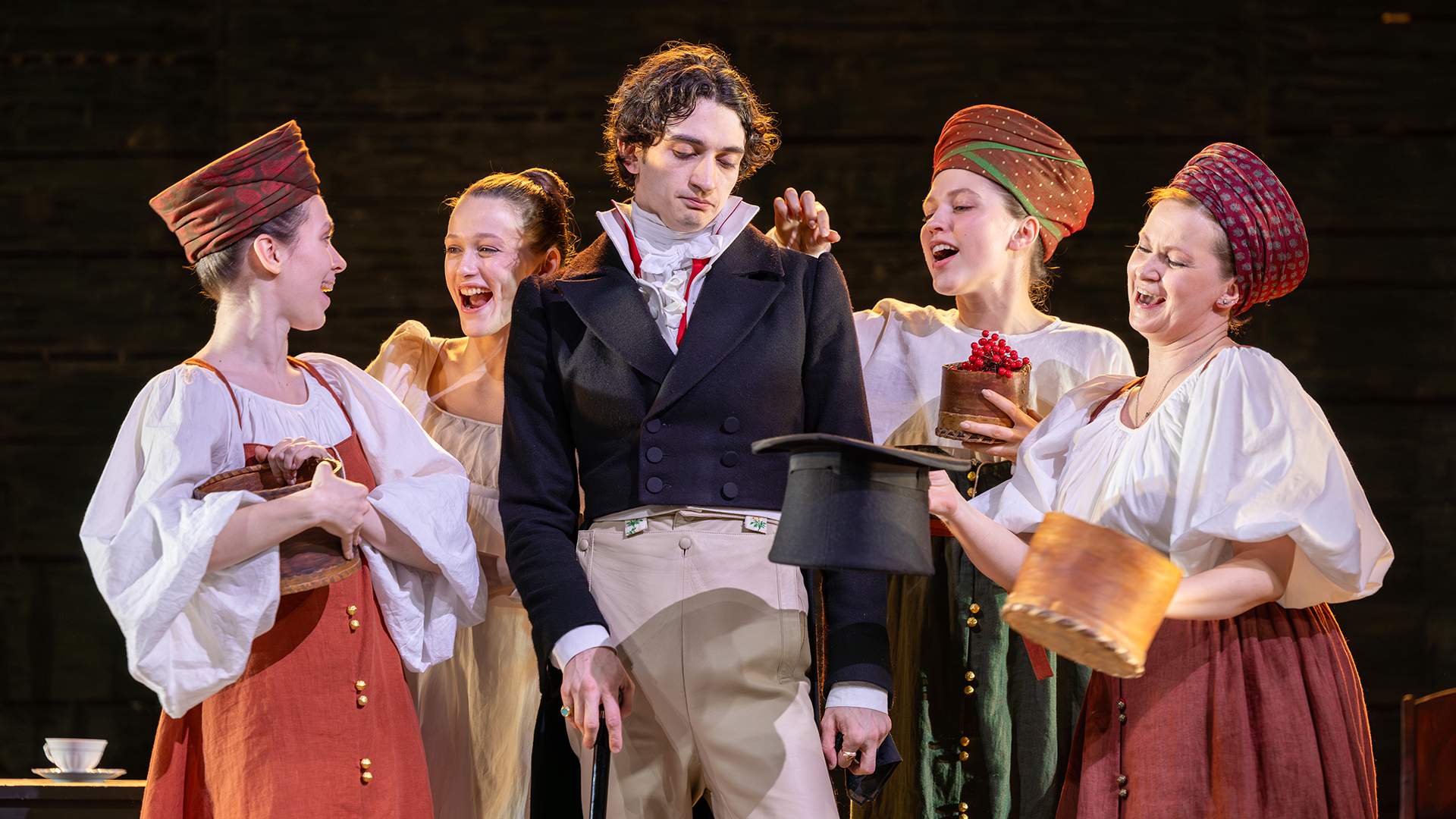
The most famous Pushkin story was told with fiction and humor by Yegor Peregudov, the Mayakovsky Theatre's director. In addition, he emphasized the love of the author and his characters for the coldest season of the year. The aesthetics of natural materials, created by stage designer Vladimir Arefiev, immerses the audience in the Russian winter. In the performance, water pours on the stage, it snows and ice crashes. "Izvestia" visited the premiere and tried not to freeze.
Pocket Pushkin
Belinsky called Pushkin's novel "Eugene Onegin" "an encyclopedia of Russian life." Director Yegor Peregudov refutes this title. Guests of the Mayakovsky Theater are greeted by a poster where Pushkin is reading a newspaper in which the first chapters of his novel in verse are published. And in the foyer there is a chance for guests to be photographed together with "our everything".

On the chair next to Alexander Sergeevich you can take the yellowed press in your hands. The newspaper "Severnaya Bee" № 16 of January 21, 1837. There was published a note about the miniature edition of the novel "Eugene Onegin": "Two words about the edition. It is beautiful: printed in a cozy format, small but very clear and beautiful font on white paper. "Onegin" of this edition will fit in the work bag of a lady, and in the pocket (not secretary) of a man", - announced the article.
In the same pocket format made and programs for the premiere. In them you can read about the novel, Pushkin's characters and the director's idea. These details set the mood for the result of the painstaking and meticulous work of Yegor Peregudov's team.
The audience will not hear the familiar text of the beginning of the novel "My uncle of the most honest rules...". But they will see that uncle played by Evgeny Paramonov. He is the narrator here, immersing the audience in the material.

The director distributed the text from the author to the characters. From this familiar lines sound in a new way. And if the dramaturgy required it, the author's lines were rearranged. For example, in Peregudov's Onegin reads Tatiana's letter, but does so only in the finale. But this did not make the play lose.
- Initially it was not intended that this work would ever be staged," says Yegor Peregudov. - There is no direct speech at all. The protagonist practically throughout the novel is silent (except for Pushkin, few people speak at all). That's why the stages of my work with the text were different: of course, first there was the stage of "falling in love" with the material, and then there was panic, it was completely unclear how to work with it. And that's the most interesting thing, because you have to do something you don't know how to do.
Onegin or Pushkin?
The chronology of the novel in verse covers the period from 1819 to 1825. At this time, the Decembrists are preparing their uprising, the country is inspired by the victory over Napoleon. And against this historical backdrop, the love story of Eugene Onegin and Tatiana Larina unfolds.
Gathering the ensemble for his performance, Peregudov relied on young people. The role of Onegin is played by Mamuka Patarava. A year ago he received a diploma from the Shchukin Theater Institute. The pupil of Anna Dubrovskaya at first dumbfounded by the created image. Although Pushkin does not give a description of Onegin's appearance, but through the efforts of Tchaikovsky, who wrote the opera, the hero of the novel is represented by a kind of brown hair with blue eyes. "Trimmed in the latest fashion, / Like a dandy Londoner dressed." An object of adoration for young maidens with a haughty look.

But when Mamuka Patarava appears on stage in a fitted fur coat, a voluminous cylinder and high boots, the familiar profile of Pushkin appears before the audience. And the most well-read recall the poet's graphic self-portraits in the margins of the manuscript. Black curls, looking down, straight back, nesuetnaya plastic. Purely demon. By the way - the young actor Mamuka Patarava plays Mephistopheles in the play "Mayakovsky" "Faust". And now he is Onegin.
-This is a coveted role for many artists, including me, a "pillar" in Russian literature, it is fully associated with our culture,- says Mamuka Patarava. - When I learned about the role, I experienced five seconds of happiness and gratitude. Then I called Egor Mikhailovich. As soon as I finished, I realized - that's it, it's a disaster, and what is there to play? After all, it's not a drama, not a play... And the search began!

The director gave the role of Tatiana Larina to Varvara Bochkova. The actress has been with the Mayakovsky Theatre company since this season. She has a ballet background: Varvara studied at the Vaganova Academy in St. Petersburg. Stretching, plasticity of the actress the director actively uses. Varvara in a nightgown jumps grand jeté and pas de poisson. Tatiana's love for Onegin makes her head explode. She rushes around the stage, then runs out into the hall and runs circles around it. The girl is overwhelmed by her feelings. Only the nanny can "ground" her.

The director suggested that Tatiana Orlova, Honored Artist of Russia, play the old lady. She can be left alone on stage and listen, listen, listen to Pushkin as read by the actress. Tatiana's nanny is a real piece of work. Looking at the scene, you believe that the girl's mentor is "with the past". Once a girl of 13 years old was given in marriage. The nanny married Vanya, who was younger than her. What love is, she does not know. Therefore, the nanny is interested in carols with Tanya's friends. "To whom it comes, it will come true. Whose ring?" - they sing. "Mine!" - rejoices the nanny, dancing. "The one who will have a baby," laughs the young people.
Dancing with chairs and broken icicles
In the performance much attention is paid to stage movement. Choreographer Igor Sharoyko has even staged dances for Onegin and Lensky sitting against each other in chairs. This is unexpected, temperamental and imaginative. At the ball with chairs, all the characters dance.

From the moment the curtain opens, not only the material is intriguing, but also the scenography by Vladimir Arefiev, People's Artist of the Russian Federation. In the center of the stage is a metal bathtub. Around it there are armchairs, next to it there is a table with various small things. In the right backstage there is a pile of flat stones. But the center of attraction is the fence at the back of the stage, through the boards of which water seeps with varying degrees of intensity. The possibilities of the machinery make it possible to completely flood the theater with water, and the audience can only guess when this dam, which is held back by the board fence, will burst.
Vladimir Arefiev knows how to surprise. He came up with the design of the performance, following the director's idea. Egor Peregudov decided to place his actors in the space of the Russian winter. The director got this idea from Pushkin's "icy predilections", which he bestowed on Onegin.
- There are wonderful memories of Pushkin: he loved the cold, - informs Egor Peregudov. - When he worked, he drank ice water in glasses and ate gooseberry jam. Not coffee, not tea, not champagne, not wine - ice and some kind of sour sweetness. Onegin in the novel takes a bath with ice in the village - and Pushkin himself went out into the hay, where there was a tub of water. In winter, the water would freeze, and he would break through the ice with his fist and in the morning after waking up, climb in, wake up, and go to work.

Onegin will have to break the ice in the performance. The creators of the performance explore the natural elements. In Vladimir Arefiev's sets, different states of water show the volatility of the author's slogan and the volatility of the protagonist.
To the lines "Frost and sunshine; it's a wonderful day!" the stage is covered with snow. The director considered the appearance of Pushkin's poem "Winter Morning" in the performance based on Alexander Sergeyevich's novel to be organic. And the space of the winter forest, where Onegin and Lensky shoot each other, the artist created with the help of bed linens. On the stage there are white blankets and pillows resembling snowdrifts. Abstract forms, but there is intrigue here too. You pull back the corner of one blanket, and there is Olga. You lift another, and under it is Lensky. There's life everywhere. Which one of the characters is about to lose.
Vladimir Lensky was played by Nikita Yazykov, a graduate of the Moscow Art Theater Studio School from Marina Brusnikina's course. The two-meter tall young man looks comical next to the low-built fop Onegin. His hero is a poet. Disheveled, nervous, restless. Everything is clear in his life, he has been friends with Olga (Alena Vasina, Nikita's classmate) since childhood and is preparing for his wedding. And it is unclear what brings him closer to the bon vivant Eugene. As Pushkin writes: "They came together. Wave and stone, / Verse and prose, ice and flame / Are not so different from each other".

The aesthetics of natural materials inherent in the production blows us away in the finale. Giant icicles appear on stage. At first it seems that they are made of plexiglass, but when the drops start, you realize: the artist is a naturalist. Vladimir Arefiev froze real ice-cubes for the performance. They are broken with a cane by Eugene Onegin, who has learned that the girl in the crimson beret, the same Tatiana, "has now been given to another and will be faithful to him for an eternity".
Shortly before the premiere, the Mayakovsky Theater launched an educational project for the audience - an intellectual talk show "Table Period". This is a public conversation, a creative brainstorming of the theater's artists and directors together with invited experts on the topic of the future performance, which will become part of the video podcast. The first meeting was held for the premiere of "Eugene Onegin". The collective immersion of spectators and creators in Pushkin's text gave birth to a new format of co-creation. Although this is a process usually closed from outsiders. But the "Table Period" will help to understand the creators' intentions more deeply.

The first spectators of "Eugene Onegin" met Yegor Peregudov's production with applause. The next show - February 8.
Переведено сервисом «Яндекс Переводчик»
