August 9 — Victory Day of the Russian fleet at Cape Gangut: the history of the memorable date
- Новости
- Local news
- August 9 — Victory Day of the Russian fleet at Cape Gangut: the history of the memorable date

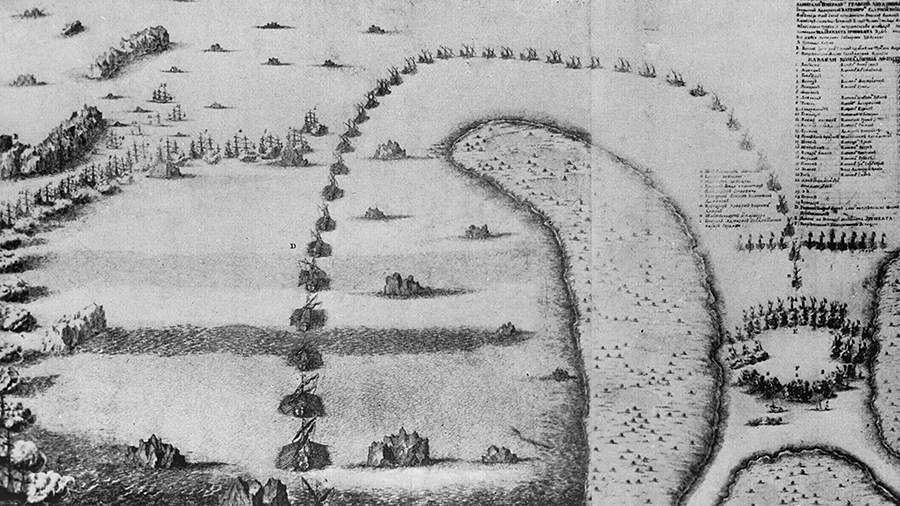
Every year on August 9, Russia celebrates one of the days of military glory, dedicated to the first major success of the Russian fleet, Victory Day over the Swedes at Cape Gangut. In 2025, the memorable date falls on a Saturday. Read about how Russian sailors changed the course of the Northern War in the Izvestia article.
The story of the victory of the Russian fleet over the Swedes at Cape Gangut
The Battle of the Gangut Strait is one of the most striking and significant moments of the Northern War between the Russian Empire and Sweden, which lasted from 1700 to 1721. In this conflict, Tsar Peter I pursued ambitious strategic goals: to regain the Swedish territories lost in the XVI–XVII centuries and to ensure free access to the Baltic Sea for Russia.
In the early years of the war, Russian forces achieved notable successes on land, capturing most of central Finland, as well as important ports in Livonia and Estonia. However, the Swedes retained control of the Baltic Sea.
In the summer of 1714, the Russian fleet, consisting of 15,000 sailors under the command of Admiral General Fyodor Apraksin, set out on a campaign to the Aland skerries on 99 galleys and scampeys, light rowing vessels. They intended to strengthen the garrison in Abo, located 100 km from Cape Gangut, capture the Aland Islands and, under favorable conditions, land on the Swedish shores.
However, the Swedish fleet under the command of Vice Admiral Gustav Wattrang stood in the way of the Russian forces. The enemy fleet consisted of 15 battleships, three frigates and a detachment of rowing vessels. Realizing that the Swedes had an advantage on the high seas, Apraksin decided to retreat and wait for instructions from Peter I.

The tsar personally arrived at the battlefield to assess the situation and take command. After reconnaissance, it was decided to build a land crossing in a narrow isthmus, along which it was planned to drag several scampers and suddenly attack the Swedes from the rear. Such a maneuver was supposed to bring chaos to the enemy's ranks and create conditions for the breakthrough of the main forces.
However, the scouts informed Watrang about the preparation of the maneuver. In response, he sent a flotilla of nine ships under the leadership of Niels Ehrenskjold to the collision site, as well as another detachment of ten ships to attack the rest of the Russian fleet. Wattrang himself remained at Gangut with his seven battleships and two frigates.
The Russian marines noticed the movement of the Swedish forces and hurried to inform Peter I. The Tsar decided not to wait — to divide the enemy forces and immediately proceed to the attack, abandoning the planned crossing. Thus began one of the most famous naval battles of the Northern War — the Battle of the Gangut Strait.
The morning of August 6 (July 26, Old style) was chosen for the start of the breakthrough. In summer, there was often a calm in the Gangut area in the morning, which caused Swedish sailing ships to lose a lot of maneuverability. Such weather was good for Russian rowing vessels, so Apraksin ordered 35 scapegoats to bypass the enemy beyond the range of artillery volleys. The Swedes were trapped.
The battle continued the next morning. A negotiator was sent to the Swedish commanders with a proposal to surrender without a fight, but Ehrenskjold resolutely refused. After that, Apraksin gave the order to attack. The Russian sailors quickly approached the enemy and managed to force a boarding battle on him, which ended in the complete defeat of the Swedish troops.
As a result of the Battle of Gangut, Sweden suffered serious losses: its fleet lost 10 ships, 116 guns and 350 sailors. Another 237 people, including Ehrenskjold, were captured. The losses of the Russian side amounted to 127 dead and 342 wounded. Not a single Russian ship was sunk or captured. After the defeat, the main forces of the Swedish fleet were forced to retreat to the Aland Islands.
Gangut battle — results and significance
The Battle of Gangut was of great military and political importance for Russia. The defeat forced the Swedish fleet to leave the Gulf of Finland. This allowed the Russian side to ensure the defense of the gulf, establish supplies for troops in Finland, and also begin active work on the offensive in the southern and central parts of the Baltic Sea.

However, the main result of the battle of Cape Gangut was a demonstration of the power of the young Russian fleet. For a long time, Sweden was considered invincible at sea, but the dedication of the Russian sailors and the foresight of the command proved that even such a formidable opponent can be dealt with. Peter the Great equated this success with victory in the Battle of Poltava, one of the key land battles of the Northern War.
More than 130 naval officers received gold medals for their participation in the Battle of Gangut. Among the lower ranks, more than 3,000 people received honorary awards. Peter the Great was awarded the rank of Vice Admiral. The tsar even began to receive an official salary of about 2.2 thousand rubles a year.
Earlier, Izvestia reported on the history and traditions of Moscow Sky Defenders Day.
Переведено сервисом «Яндекс Переводчик»
